Lecture 1
Characteristics of FX Markets:
- Largest of all financial markets with average daily
turnover of over $8.5 Trillion! Spot transactions - $2
trillion; FX swaps dominate.
- short term instrument, buy and within a week period
- Banks use for liquidity
- 64% of all foreign exchange transactions involves cross-
border counterparties
- counterparty, or pushed-out risk
- Only 6% of daily spot transactions involve non-financial customers.
- US dollar involved in one-side of 85% of all trades, a slight decline from the 2019 survey; Euro is at 31%.
- Australian $AUD is the 5th most heavily traded currency
- Loosely organised in two tiers: wholesale & retail
Characteristics of Wholesale markets
- Not an organized exchange
- No fixed opening hours, centralized clearing mechanism, standardized contracts, etc.
- No equivalent of a stock market or derivative market
- Extremely deep and liquid market
- trade sizes 200-500M
- Participants in the market:
- International banks
- 100-200 banks willing to buy/sell foreign currency in their own account
- Bank customers engaged in commercial and Investment transactions, BHP, QIC, e.g.
- Non-bank dealers
- FX brokers
- Central banks
- International banks
- Settlement of transactions – No real money changes hands
- The role of SWIFT
- Communication System
- Society of Worldwide International Financial Telecommunications
- Money often more through multiple banks before ending in the correct accounts
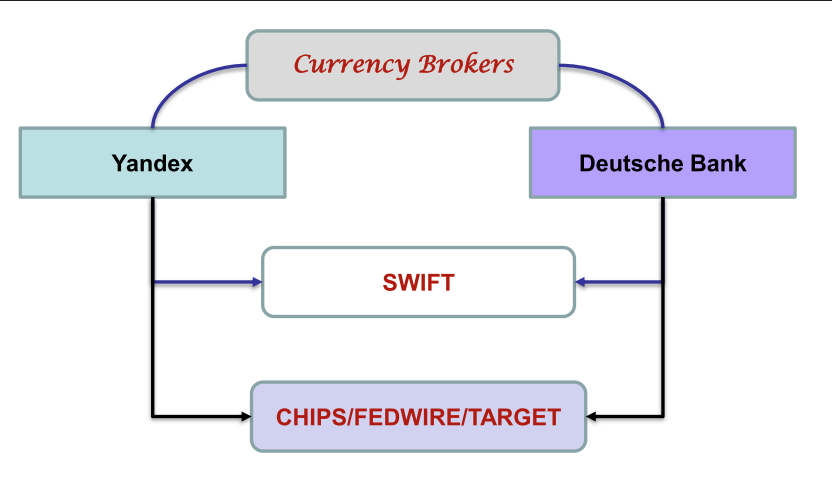
- chips, fedwire, target - organisations to transfer money
Exchange rate
-
A foreign exchange rate is the price of one currency expressed in terms of another currency.
-
A foreign exchange quotation (or quote) is a statement of willingness to buy or sell at an announced rate.
- Market makers - foreign currency dealers and brokers
- binding quotes for a few minutes
-
normally quote to four digits
-
normally settles T+2
-
have all the contributors at the bottom, with their bid/ask
Terminology
- Spot Rate: The exchange rate at which trades are executed immediately in the interbank market. About a third of all FX trading is done in this market.
- Value Date for a spot transaction is the date on which parties receive the funds they have purchased – e.g., in trades involving USD, settlement occurs two business days after the deal.
- Foreign currency dealers provide two quotes: - Bid Price: Price at which the dealer is willing to buy a currency from you (i.e., client) - Ask Price: Price at which the dealer is willing to sell a currency to you (i.e., client)
- It is always the case that the Ask Price > Bid Price. The difference is the Bid-Ask spread
- The less traded and more volatile a currency, the greater is the spread.
Bid/ask prices
USD - base currency CHF - Quote currency
- the rate at which the bank will buy USD (base currency) in exchange for CHF (gives customer swiss francs)
- the rate at which the bank will sell USD (base currency) for CHF (receives swiss francs from customer)
-
In the wholesale market, for a currency pair, there is a base currency (the first currency in the pair), and quote currency (the second). This is what Bloomberg uses.
-
Other quotations used in business include
- Direct Quote: Home currency per unit of foreign currency (FC)
- Indirect Quote: Foreign currency (FC) per unit of Home currency
- American & European terms are direct and indirect quotes relative to the US dollar (USD). The quote in the previous slide is in European terms.
-
Note that in all cases, the reciprocal of a direct quote is an indirect quote and vice-versa.
Example, AUDCHF
AUD - Base currency CHF - Quote currency If AUD is local currency, this would be an indirect quote
-
Cross-rate is an exchange rate that does NOT involve the USD
-
Explain the following quotes:
-
the amount of AUD the bank would buy from you in exchange for 1 CHF
-
the amount of AUD the bank would sell to you in exchange for 1 CHF
-
Bid and Ask prices mixed with alternative quotations methods can lead to confusion. Try to remember:
- The dealer buys the denominator (or base) currency at the BID [client buys the numerator (or quote) currency at the bid]
- The dealer sells the denominator (base) currency at the ASK [client sells the numerator (or quote) currency at the ask]
-
When all else fails, remember that the commercial client always, ALWAYS gets the worse end of the deal
Another Example
American terms (e.g. British Pound)
| Bid | Offer (ask) | |
|---|---|---|
| $/£ | 1.2749 | 1.2750 |
- Bid: Dealer buys £ for $ at the Bid, Client sells £ for $ (i.e., dealer will buy £1,000,000 for $1,274,900)
- Ask: Dealer sells £ for $ at the Ask, Client buys £ for $ (i.e., dealer will sell £1,000,000 for $1,275,000)
Inverse exchange rate
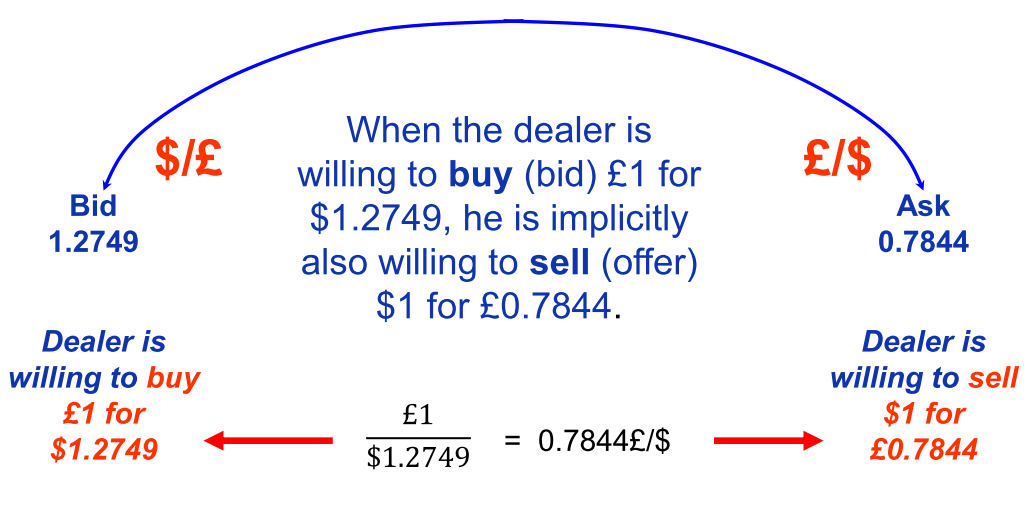
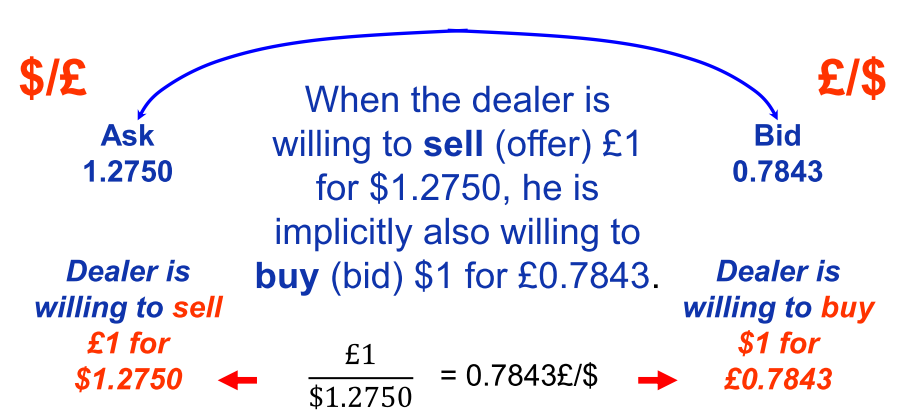
- a direct bid is the reciprocal of an indirect ask
- a direct ask is the reciprocal of an indirect bid
Bid-Ask spread
- The difference between the bid and ask prices is the bid-ask spread. It represents a “round-trip” transaction and is the cost of entering into the transaction.
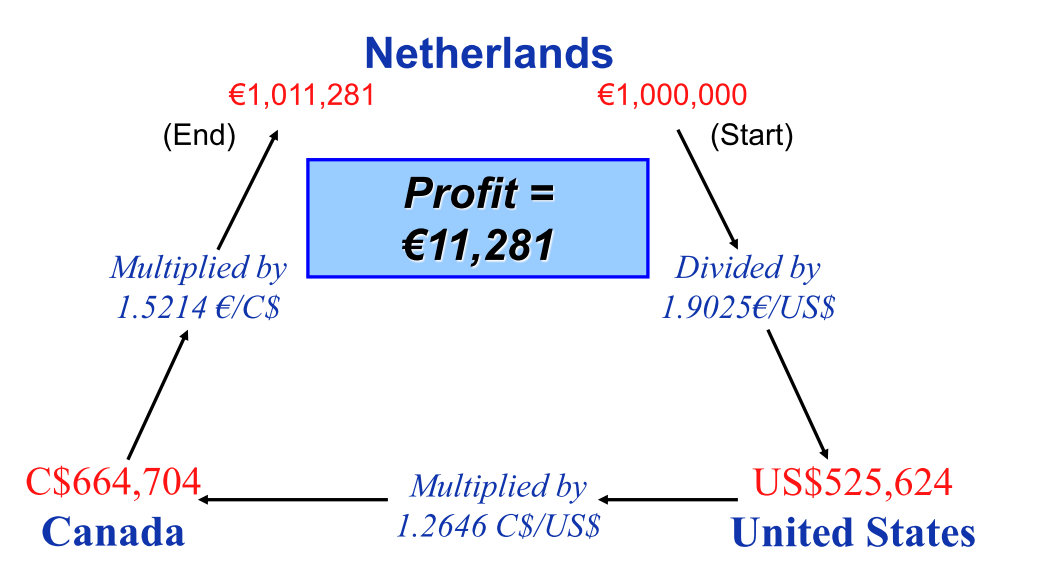
Triangular arbitrage
- Cross rates can be used to check on opportunities for intermarket arbitrage. Suppose the following exchange rates are available:

- The synthetic (manufactured) cross rate between Euros and Canadian dollars is:
Arbitrage example
Forward contracts
- Forward transactions require delivery at a future date of a specified amount of one currency for a specified amount of another currency.
- This is a rate that is agreed upon today but settled further into the future.
- Forward contracts are traded on the inter-bank market. They can be tailored for
- contract sizes
- currency
- delivery dates
Ways to quote forward rates
- There are three ways to express forward rates:
- Via points to be added or subtracted from spot rate [known as swap points]
- Outright quotes
- As an annualized percentage forward premium or discount
Forward quotes: Swap rates
-
Among themselves, foreign exchange traders usually quote forward rates in terms of points, also referred to as “forward points” or “swap rates”
-
A point (pip) is the last digit of a quotation
- A point (pip) is equal to 0.0001 (1/100 th of 1%) for most currencies.
- The Japanese yen is the exception. It is quoted only to two decimal places; A point, in this case, is 1/100.
-
If F > S then the currency in the denominator (base currency) is trading at a premium
- E.g. One AUD buys more USD in the forward market than the in the spot market
- If ascending between bid/offer forward points then forward price will be higher than the current spot price
-
If F < S then the currency in the denominator (base currency) is trading at a discount*
- E.g. One AUD buys less USD in the forward market than the in the spot market
- If descending between bid/offer forward points then forward price will be lower than the current spot price
- If F = S then market is relatively flat
Swap rates
- A forward quotation expressed in points is not a foreign exchange rate as such.
- Rather, it is the difference between the forward rate and the spot rate.
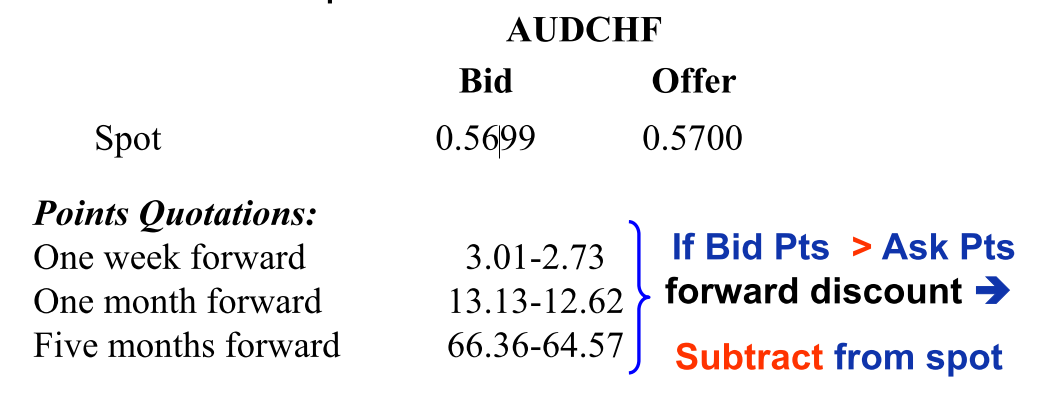
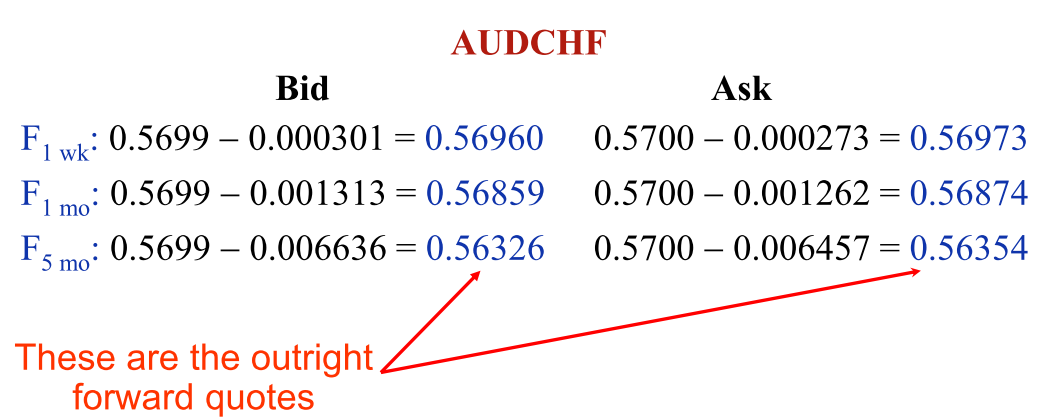
When the Bid Points > Ask Points, you subtract the points from the spot rate to get the outright forward quote:
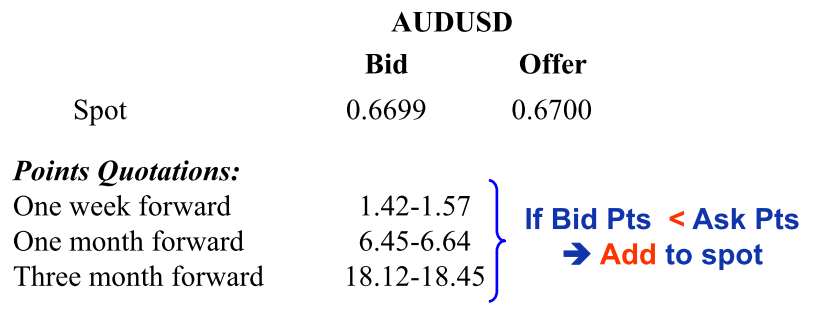
If the Bid Points < Ask Points, there is a forward premium, and you add the points to the spot rate to get the outright forward quote
Forward premium/Discount
- A forward premium exists when a currency purchases more of the second currency than it does previously
- This implies that the base currency appreciates
- A forward discount exists when a currency purchases less of the second currency than it does previously
- This implies that the base currency depreciates
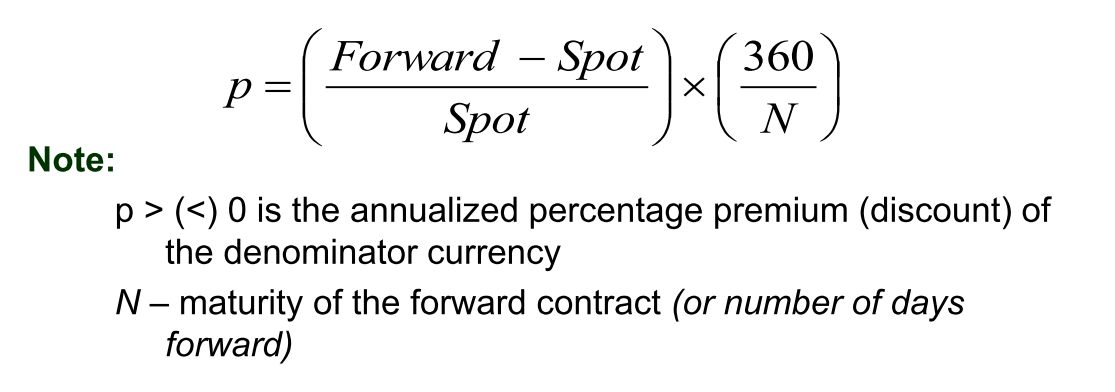
% change in exchange rates
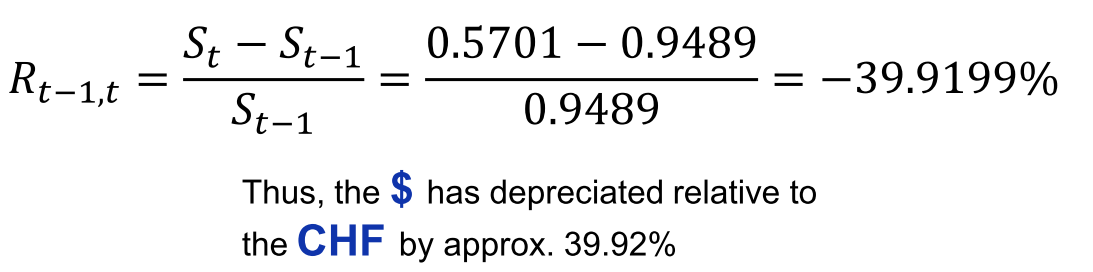
The Australian dollar was quoted at CHF 0.9489/AUD in January 2013, while in January 2024, it was quoted at CHF 0.5701/AUD*
- At t-1 (Jan 2013): CHF 0.9489/AUD
- At t (Jan 2024): CHF 0.5701/AUD.
Thus, the appreciation/depreciation of the $, relative to the CHF from t-1 to t is: