Revision Lecture 4
Foreign Currency derivatives
- These are financial instruments whose value depends on an observable value
- Derivatives include:
- Options: A contract that grants the holder the right, but not the obligation, to transact in an asset.
- Futures: A contract to buy or sell a commodity at a point in the future. Changes in prices in the commodity are settled daily.
- Swaps: A contract in which two parties exchange cashflows from different financial instruments.
Futures and Forwards
Currency forward and futures contracts both represent an obligation to buy or sell a certain amount of a specified currency some time in the future at an exchange rate determined now.
| - | Futures contracts | Forwards Contract |
|---|---|---|
| Markets: | Prices determined in centralised exchanges | Decentralised interbank market |
| Trading Hours: | Most trading during exchange hours | Open somewhere around the world |
| Contract size | Standardised sizes depending on currency | Standard size of $1m etc. and can be tailored |
| Contract maturity | Fixed delivery dates: 3rd Wed. of March, June Sept or Dec. | Fixed maturities (1, 3, 6 or 12 months) or can be tailored to specifications |
| Quotation: | American terms (USD/FC) | American (USD/FC) or European (FC/USD) |
| Settlement | Delivery of underlying fx is feasible, but almost never occurs. Position closed out by taking an offsetting position | Delivery of foreign exchange normally takes place |
| Security against default | Clearing houses stand behind traders | Assets of bank |
| Required collateral | Margin requirements ("Performance bond") | Deposit required if not standing relations with bank |
| Cash flows | Occur daily because of "market-to-market" feature | No cash flows until forward contract matures |
Options contracts
Options contracts give the option holder the right, but not the obligation to buy or sell a specified amount of the underlying asset (currency; stock) at a pre-determined price (exercise or strike price).
Basics of Options
'The right, but not the obligation'
- Types of Options
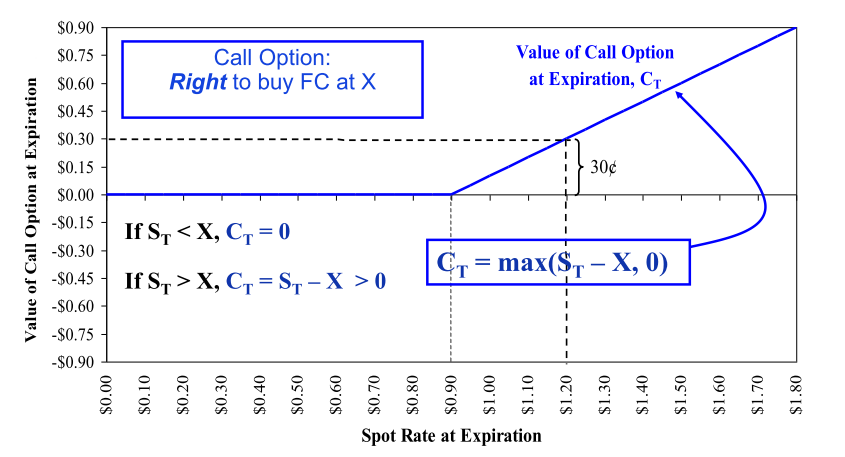
- Call: gives the holder the right to buy
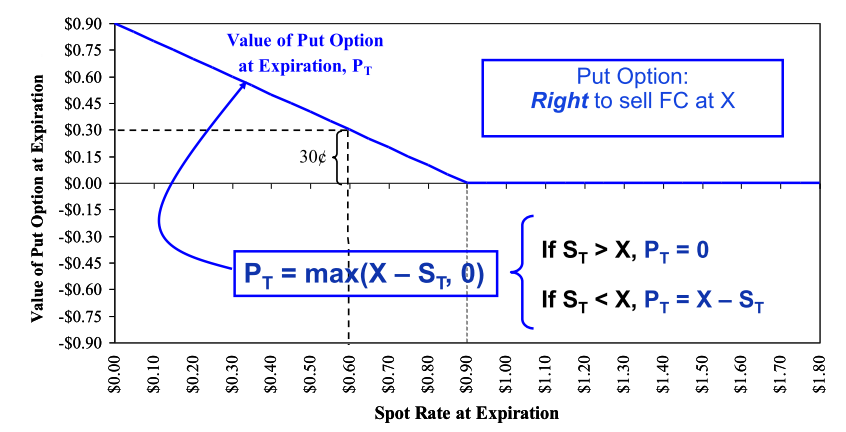
- Put: gives the holder the right to sell
- An American option gives the buyer the right to exercise the option at any time between the date of writing and the expiration or maturity date.
- American option will always be more expensive than an equivalent European option (of the same terms)
- A European option can be exercised only on the expiration date, not before.
- The exercise or strike price (X), which is the exchange rate at which foreign currency can be purchased (call) or sold (put).
- The premium, cost, price, or value of the option itself (paid in advance by the buyer to the seller).
- The underlying or actual spot exchange rate in the market.
Value of a call option at Expiration
Value of the put option at Expiration