Revision lecture 6
Hedging Economic Exposure
Change in real exchange rate
- Suppose inflation in Australia (UK) over the next year is 4% (8%). Also, the nominal exchange rate changes in line with Relative PPP predictions.
- The £ weakens by 3.7%
- What is the new Real Exchange Rate?
- New price levels are $15,600 (=15,000×1.04) and £12,960 (= £12,960×1.08) in Australia and the UK respectively
- Notice, the real exchange rate has not changed. This is because relative PPP holds. This keeps deviations from absolute PPP constant.
Real exchange rate change
- Real exchange rate, E, can change over time. This is given as
- If the % change in E is positive, we have real appreciation of B.
- If the % change in E is negative, we have real depreciation of B.
Real exchange rates and Profitability
- Real Exchange Rates affect real profitability which is the nominal profits divided by the price level.
- Why is real profitability important?
- Consider the case of an Australian exporter of mangoes (M). His costs are incurred in AUD.
Revenue from sales:
Revenue from French Sales
Cost of Production
- The exporter's real export revenue from sales to France is
- The exporter’s real export revenue depends on three factors
- The real exchange rate;
- The relative price of mangoes in France; and
- The quantity of mangoes sold in France
The Source of Economic Exposure
- Economic exposure arises when the value of the firm is affected by
changes in the Real exchange rate. Exchange rates affect the value of
the firm through their impact on
- Revenues;
- Costs; and
- Competitive position
- It is the extent of sensitivity of the Value of a firm to an unexpected exchange to real exchange rates.
A Real-World Example: Honda Motors
-
Honda used to manufacture all its automobiles in Japan and ship them to the U.S.
-
U.S. demand declined with yen appreciation
-
In January 1993, exchange rate was about 125 ¥/ range
- ~$11,602
-
NY Times says that Japanese manufacturers would have to “take stern measures to reduce their costs and improve their efficiency.”
-
June 1993 dollar fell to about 110 ¥/$
- ~$11,364
-
End of summer of 1993, 100 ¥/$
- ~$12,500
-
In July 1993, Japanese auto exports were 14% below previous year’s level.
-
The New York Times reported Japanese manufacturers were shifting production to U.S.
-
Honda posted a 55% drop in pre-tax profit for quarter ending June 30, 1993.
-
Honda has built manufacturing plants in the U.S. to produce automobiles for sale there.
Impact of Economic Exposure
- A strong dollar can make imports look cheap to Australian purchasers.
- Can bring new competition for Australian producers.
- Exchange rates can affect the price a firm pays for inputs imported from foreign countries.
- Raise prices (lower demand) or earn lower profits?
- Exchange rates can affect the foreign demand for a firm’s product.
- Weak dollar can make Australian exports attractive.
- Increase in foreign demand can also increase Australian prices if production doesn’t adjust fast enough.
Quantifying Economic Exposure
- PV of firms profits/CFs is given as
- It measures the marginal impact on firm value by an unexpected change in the (AUD/FC) real exchange rate.
Natural Hedges
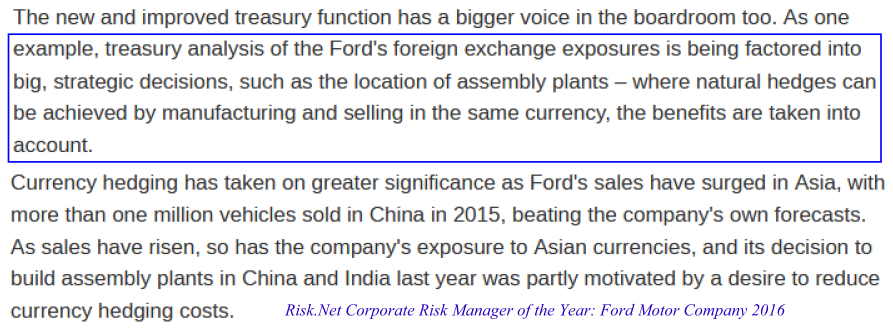
- Ford shifting production to Asia
- Toyota has insulated itself to some extent against dollar fluctuations
- It builds 60% of the cars sold in North America in North America
- Michelin, the world’s largest tire maker, has 40% of its annual sales in
North America.
- Most of the imported raw materials used by Michelin are also priced in dollars
Exchange rate Changes and Profit Margins
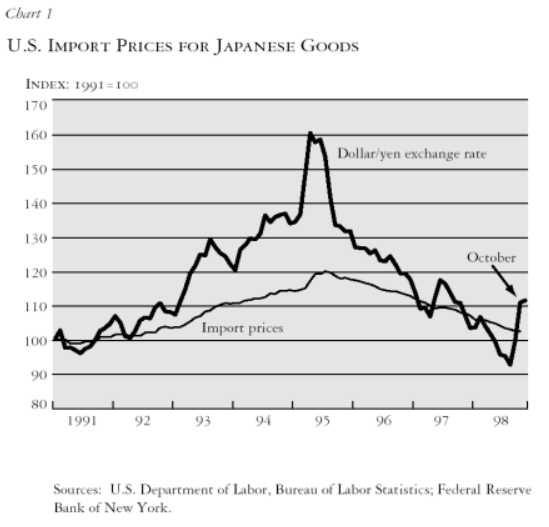
- Another way to state the findings is: Foreign customers do observe exchange-rate driven changes in prices, but the Japanese firms moderate the extent of these changes by altering their profit margins.
Why would this make sense?
- A firm that has found its profit-maximizing price in each market and will attempt to keep its goods at that price. (Cares about maintaining market share.)
- Thus, firms are inclined to absorb currency swings into their profit margins to stabilize prices seen by foreign customers.