Tutorial 1
Question 1
1) What is a derivative security
- An agreement between two or more parties to undertake financial transactions in the future dependent on (or derived) from other future events.
2) What is the role of derivative security markets in the economy?
- Derivative security markets evolved to enable business/government etc. to reduce financial and other risks that arise in their usual core business activities
From another perspective:
- The role of these markets is the reallocation of risks from parties who are not specialists at managing them, to other parties who are willing to take them on board and are specialists in managing them.
3) What is the main difference between forwards/futures and options?
- Options effectively give one party, the holder or taker, the choice of whether to enforce the agreement or not.
- A call option gives the holder the right and not the obligation to buy the underlying asset for the agreed strike price ON (European) or anytime up (American) to the expiry date
- a put option gives the right but not the obligation to sell the asset
Forwards/futures - obligation options - right, not obligation
4) How do you use futures and options to speculate on an expected increase in the price of the underlying asset over the short term? What about a decrease? Plot the payoff diagrams from your strategies.
- long on futures/forwards: payoff =
- buy a call option: payoff =
, spot price at time T , contract price
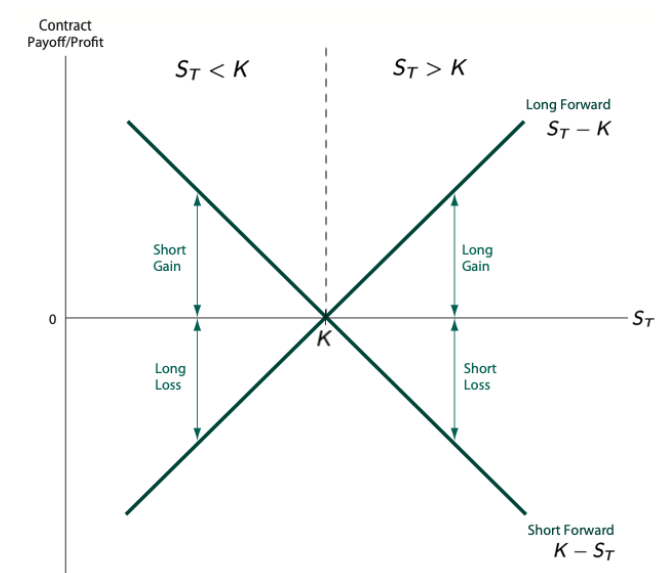
b) decrease in the price of the underlying asset
- short on futures/forwards: payoff =
- buy a put option: payoff =
Note: does not incorporate option premium
(5) Suppose you hold a S&P/ASX200 index ETF and you’re worried about the falling over the short term, but you don’t want to sell your holding.
- To manage the risk of a market fall, you short short future markets
Assumptions
- 1 futures contract is over 1 unit of the ETF, and hedging dates is exactly the maturity date of the contract.
Our position is going to be:
- ETF holding + short futures contract
- payoff:

C) One could possibly use the ASX SPI200 index or ASX mini SPI 200 index futures, or even LEPOS over the individual ETF if one exists
Question 2
What are the diff erences between OTC markets and trading venues? What is a trading venue? What is a multilateral trading facility (MTF) and what are some examples? What is an alternative trading system (ATS) and what are some examples? How do they compare to traditional exchanges? What is a central counterparty clearing house (CCP) and what are some examples?
OTC markets (Have a read in textbook or solutions) (Not very important, will touch on more during sem).
Question 3.
- Interest rates (Short answer) (Not very important, will touch on more during sem)