Lecture 1
Introduction to some general real estate principles and the concept of Real Estate as an Asset Class
Aims for FINM3406
- This course aims to provide students a detailed understanding of real estate finance and investment and the role of property as an asset class.
- Students will learn how to critically evaluate the role that property plays as an investment vehicle and to analyse investment and financing opportunities.
- The course will examine the differing roles that direct and indirect property investment has and the mechanisms for financing property transactions.
Real Estate as an Asset Class
- What is real estate – bundle of rights theory
- The way in which we treat property is the way in which we govern
- Conceptual frameworks for property ownership (socialist/communist/capitalist – liberal democratic ideology)
- Purpose of built form – historic, current and future and how this impacts investment decisions
- Real estate market characteristics
- Comparison with other asset classes
Scale of Australian Real Estate Sector
- Residential Real estate $7.6 Trillon
- Australian Superannuation $2.6 Trillon
- Australian Listed Stocks $1.8 Trillon
- Commercial Real Estate $0.972 Trillon
What is Real Estate?
- Tangible Asset (physical)
- When viewed as a tangible real estate includes:
- Land (Cuius est solum, eius est uesque ad coelum et ad inferos)
- Has to be real estate? Where does it start and stop?
- Rivers? Beaches?
- Historically a legal maximum and minimum
- Improvements on the land (appurtenances)
- merged with the land as a single asset
- Title to the land includes all the assets on the land
- Does not include removable items (plant & equipment)
- If it's fixed, then considered part of the building
- Land (Cuius est solum, eius est uesque ad coelum et ad inferos)
- Can it be Intangible (nonphysical)?
- Contractual rights (ie leases, mortgages, options etc) - NO
- Lease forms creates property rights and contractual rights
- Easements & Profit-a-prendre - YES
- Property right - access easement (e.g.).
- Profit-a-prendre - right to take from the property (harvest, e.g.)
- Contractual rights (ie leases, mortgages, options etc) - NO
- Property Rights vs Contractual Rights
- Privity of Contract vs Rights against the world
- I can only enforce my rights against the person I have a contract with
- Rights against the world - trespassing on your occupied property
- Privity of Contract vs Rights against the world
- Bundle of Rights Theory
- Ownership (private right enforceable against strangers)
- Possession (possession is 9/10 of the law)
- Control (what is built and what takes place)
- Enjoyment (can use as see fit)
- Exclusion (no trespassing)
- Disposal (sale, lease or by will) & Destruction
- These rights are not unconstrained
- Government controls (ie Planning, Environment, Heritage and Property Laws, Compulsory acquisition)
- If the government decides it wants to build infrastructure on your land they can do it
- Common law (ie nuisance)
- Can't light a fire on your land and create smoke the goes into neighbours
- Cannot dam shared river/water over properties
- Self imposed (Contracts – restrictive covenants, leases, mortgages, liens, caveats)
- Government controls (ie Planning, Environment, Heritage and Property Laws, Compulsory acquisition)
Conceptual Frameworks for Ownership
- Capitalist perspective
- Private ownership of property is an individual right
- Every individual has a right to privately own property
- Liberal democratic society grundnorm (freedom and liberty)
- grundnorm - foundational principle of liberal democracy
- Property rights - communitarial obligation (heritage buildings, environmental protection etc.)
- Private ownership of property is an individual right
- Socialist perspective
- State controls ownership and use of real estate
- State allocates land based upon society needs
- Private ownership limited – no right to buy or sell
- Communist perspective
- State owns all real estate. Private property is abolished
- Determination of how it is used an allocated
- State determines how real estate is used and allocated, with the goal of equal distribution of resources and wealth
- Hybrid models exist
- State owns all real estate. Private property is abolished
Purpose of built form – Why do we need property?
- Enclosure/delimitation of space
- Climate barrier/modifier
- barrier or modifier of climate
- Manufactuiring medicine, need modified climate
- Protection and privacy
Buildings create environmental conditions indoors which are more stable and predictable than those outdoors. In so doing they enable activities to take place that otherwise would not.
A building like a company, should help us to do more things and to make things more abundantly better
Purpose of built form – What do we need/use property for?
- Shelter
- Security
- Business base
- Corporate Statement
- Architectural and/or historical/cultural
- Investment
- Infrastructure
- Relationship with people and technology
Characteristics of Real Estate Markets
- Heterogeneous Products
- Real Property is unique
- Might be nearly identical in nearly every aspect, never the same
- Real Property is unique
- Immobile Products
- Real estate exists in a defined spatial context
- Buildings can be relocated but land is immovable
- Localised Market
- Markets differ from region to region
- Segmented Market
- Segmentation can be based on use, size/scale and location
- further drill down - layers that perform differently.
- Private negotiations with high transaction costs
- Time consuming, costly and complex
- Private negotiations between purchaser and seller
- In real estate in Australia, we are charged stamp duty - charge by the government to 'stamp' your enforce your contract
- Based upon the value of your contract
Ownership Objective
Corporate Property
- Business Base
- Corporate Statement
- Enabler of Business
- Infrastructure Facility
Investment Property
- Return On Investment
- Diversification by
- Location
- Size
- Sector
- Direct and Indirect
- AREITS
- Syndicates
Property sectors
- Residential
- Houses, apartments, affordable housing, retirement
- Industrial
- Warehouses, factories, specialist plant (ie abattoirs, refineries, mills etc)
- Commercial
- CBD vs fringe vs various grade of accommodation
- Retail
- Regional, sub-regional, neighbourhood shopping centres, bulky goods
- Leisure
- Hotel, resorts, theme parks
- Agricultural
- Farming, mining
- Infrastructure
- Roads, tunnels, airports, seaports, bridges
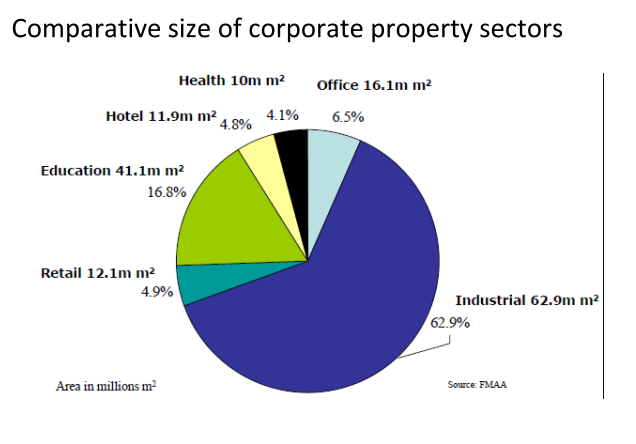
Scope of Real Property
- Public/Private
- Owner occupied/investment
- Multi purpose/single use
- Large scale/small scale
Public
- Infrastructure
- Roads, rail, ports, dams
- Services
- Health, defense, law, education, recreation Private
- Corporate Real Estate
- Investment Property
Why are decisions about property generally more complex and time consuming compared to decisions about other asset classes?
(Question has always been formed in the final exam) - would need to compare and contrast other asset classes
- Size – large capital requirements
- If you are buying or selling a piece of real estate, they tend to cost more than buying an ounce of gold e.g.
- Larger capital requirements than most asset classes
- Regulatory environment – high degree of regulatory control and compliance
- massive degree of regulatory control
- Health and Safety
- Toxic materials
- Uniqueness
- Time line – long time from inception to use/monetisation
- contracts, signing etc. Potentially no return for a very long time
- Property is a wasting asset – depreciation and obsolescence
- Built form depreciates and becomes obsolete
- Limited liquidity
- Quality of management impacts value
- Improve the value by being smart, with renovations
Equity in real estate - the equity component is the amount you own in the property, excluding the debt component