Lecture 2
- Doctrine of tenure and estates:
- Historical Perspective
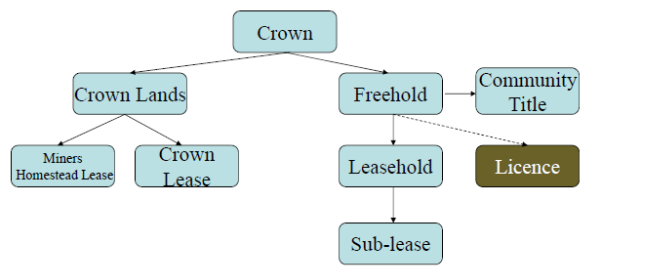
- Freehold - leasehold - licence
- Native title
- Direct Ownership & Indirect Ownership
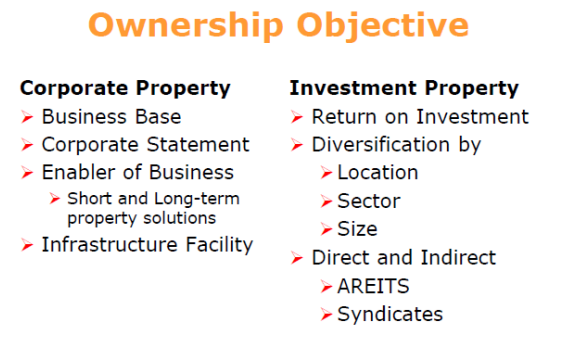
- Corporate Real Estate & Investment Real Estate
- Risk Management
Thinking about real estate and a difference framework
- need clarity of understanding about legal frameworks
- Defining some of the terms in real estate
- lease hold, frame hold etc.
DOCTRINE OF TENURE AND ESTATES
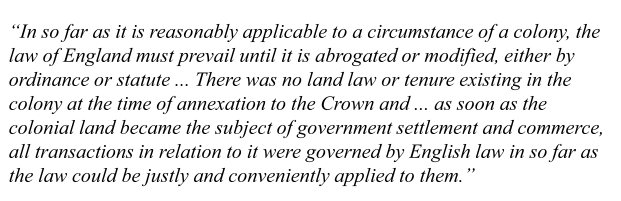
- On 26 January 1788 at Sydney Cove, Captain Arthur Phillip R.N. formally took possession of Australia as a settled and occupied colony, thus commencing the settlement of Australia and the introduction of British legal system replacing any indigenous land rights and system of laws.
- Took land where they saw fit. Planted a flag and called it a colony
- Any indigenous legal system was completely replaced.
- Historical quirk - the way in which nations expanded their territory. If you had a war with a country and won in, there were rules that applied as to how the laws changed. It mattered how you acquired territory as to the laws that prevailed.
- Capt. Phillip became governor of New South Wales, (NSW) (which at that time included Queensland and Victoria) and established a settlement.
-
Under English law, following the Norman invasion of 1066, all property was vested in the Crown.
-
Under the feudal system all lend was held from Crown various forms of service were required of the lords who occupied the land these included military, spiritual and socage (payment) and system of Subinfeudation.
- provide crops, food, labour and military support
- Or socage (payment) to the king
-
The Statute of Quia Emptores 1290 ended Subinfeudation as land owners were able to alienate by substitute without consent of the overlord, thus forming the basis upon which all estates in land are based.
- Market creating of real estate - little transaction of land
-
The Statute of Tenures 1660 converted these various tenures to a much more limited number of which socage or free tenure was the predominant. The Statue of Tenures was repealed and simplified in 1969.
-
Land is granted in fee simple is held in perpetuity from the crown without any annual payment due to the crown subject to reservations held by the crown (eg minerals and a right to take back possession of the land under a limited set of circumstances)
-
The Colony of New South Wales included what is now Queensland until 6 June 1859 when Queensland became a separate Colony.
- Constitution Act 1867 - QLD government can make any law it seems fit for 'peace and welfare and good government'
- The first meeting of Qld parliament passed the Alienation of Crown Lands Act 1860 which gave the Governor the right to grant title in fee simple or otherwise of crown waste land.
- Alienate, to give off crown land
-
On 1 January 1901 the Colonies of Australia formed a federation (by the passing simultaneous legislation in each Colony and in the British parliament). The Commonwealth of Australia was established, and the Colonies became States.
- States gave up specific enumerated powers to the federal government
- The States did not give up the power to grant land and make laws about property.
- With commencement of the Australia Acts on 3 March 1986 Australia became fully independent of the British parliament and its courts.
Each state has their own property law frameworks
Doctrine of Tenure, Estates & Waste
- Doctrine of Tenure (spatial)
All land is held by way of grant from the Crown (or in modern language from the State)
-
Crown gives you the land but still has the right to take it back
-
Doctrine of Estates (temporal) (estates in possession)
All land tenure gives the owner the right of possession for specific duration (an estate can be a future interest – ie vested vs contingent)
-
Freehold – uncertain duration
- Fee simple (akin to absolute ownership)
- Fee tail (historical – inheritance limited to certain descendants)
- Life Estate (granted for duration of a person’s life – remainder/reversion)
-
Leasehold – certain duration
- NOTES: the space can be held for a period of time. What is the estate, and how long do you have to own the estate?
- contingent estate: getting a property contingent on a contract/agreement
- freehold estate - specific, but uncertain. IF you own a block of land and it is yours, you own it until you pass away or sell it etc.
- Estate in fee simple is absolute and you have no constraint transferring or disposing it by a will
- Fee tail was abolished about 100 years ago
- Freehold life estate, can own the property until they die, and it is then inherited by someone else
- Owned by the 'remainder man'
- reversionary interest is who is left with after the life estate is gone
- Interest that is linked to the death of a person
- Leasehold: for a certain duration, for a defined period. If the interest of the land is for a certain duration,
-
Doctrine of Waste
Owners of limited estates (ie less than fee-simple) are limited in their use of the land (ie cant do things to degrade its value) to protect future interests
- NOTES: e.g. a life estate, person living cannot put a bulldozer through it
- If you diminish future interest property they have a right to sue
Freehold
-
Fee Simple Absolute in Possession.
- Not subject to determination it is held in perpetuity without limit. In possession refers to an immediate estate that can be held now.
- The alternative is a remainder interest or life interest which is dependent on the life of an individual.
-
Land title was originally based on deeds; a written, witnessed record of ownership (trail of contracts).
-
In Queensland this has been replaced by the Torrens title system which provides for a system of registration.
- Your title is indefeasible if it is registered. If there is a title with a name on it they own it
-
Each registered title is indefeasible.
-
NOTES: deeds - pouring dirt into one's hands
Leasehold
Crown leases – State grant of leasehold tenure (approx. 75% of Queensland is leasehold land)\
- agricultural or mining projects
- Maintain good habits in the early settlement; make it a condition of the agreement to make building of certain size, etc.
- give farmers leases and make certain amounts of land cleared every year
Private leases (between an owner of fee-simple and a lessee or a lessee and a sub-lessee)
- A written agreement or contract between two parties which creates a tenancy.
- A tenant is a person(s) holding land under a landlord in leasehold tenure, usually a contractual tenancy for a certain period under which is paid an annual rent as a consideration for the right to exclusive possession.
- Essential elements of leasehold tenure are
- Privity of estate (same land held by both parties)
- Privity of Contract (both parties have contractual obligations with each other).
- NOTE: can't always get a copy of a lease, does not have to be registered.
- Where there is an agreement between two people, this creates a tenancy. Lessee, lessor. The person who gives something is the 'or'. The person receiving (the benefit) is the 'ee'
Types of Leasehold Tenure
- Tenant for a term
- Specific tenancies
- Periodic tenancies
- NOTE 5-year, or month-to-month?
- Tenant at Will
- Ongoing until immediately termination by either party
- both parties have the ability to terminate with two weeks notice
- Ongoing until immediately termination by either party
- Tenant at Sufferance
- one who comes in by right and holds over without right (not a trespasser)
- Bound by terms of previous lease
- NOTE: had a formal lease for a period
- If you are on a property without an agreement, you are a tenant at Sufferance. Still bound by the terms of the previous lease
Rights and Obligations under Leasehold Tenure
- Written contract is the primary source of rights and obligations between the parties
- Part VIII of the Property Law Act 1974 (QLD)
- s 105 - tenant’s obligation to pay rent, keep in repair etc.
- s 107 - landlord’s right to enter, repair etc
- NOTES: regardless of what the contract says, you have an obligation to...
- NOTES: if tenant, obligations to the building that you occupy
- Common law - implied terms and conditions
- Tenant right - quiet enjoyment
- Landlord obligation - non derogation of grant
- NOTE: laboratory, use the lab for complicated testing. Next door impacts machinery. The landlord cannot rent you space out because it impacts the purpose of your contract.
- Double-edge sword - when you rent property, you will be told the purpose in which you can rent it
- E.g. rent the 25th floor of an office building. Landlord turned off all the lifts. Non-derogation of grant
- Allowed to use the land for the purpose and nothing else.
- NOTES: up to you as a private individual to negotiate your lease.
Licences
- A licence is a contractual right and merely gives the licensees the right to use the premises for a given purpose and to do something rightfully on the land which would otherwise be a trespass.
- A lease conveys an estate in the land to the tenant, a licence passes no estate in the land to the licensees.
- NOTE: lease is a property right, you can sell it
- A lease when granted cannot be revoked (subject to termination rights for breach) - but the grantor of a licence may revoke it at any time, upon reasonable notice.
- NOTE: may be able to settle the licencor for damages, but the original agreement may no longer be enforceable
- A lease can be assigned to a third party in the absence of express stipulation to the contrary; a licence (unless coupled with an interest in land) cannot be assigned.
- NOTE: important to know the difference, changes the risk profile
- If it doesn't give you exclusive possession of the property for a period of time, it is a licence
- Normally a clause in the agreement the the new owner would take over all the leases and licences originally.
- Example: lease a building but licence the car park. Rocklea markets, buy fruit and veg, plus retail vendors. 4x4 blocks would be yearly licences.
Breakdown
- Big bulking building like bunnings, community title.
Native title
-
International law of the 18th century recognised four ways of acquiring sovereignty over a new territory: by conquest, cession, occupation or annexation. Settlement in 1788 was regarded as being akin to occupation of uninhabited lands (not really true though).
-
In 1992 the High Court decision in Mabo v Queensland rejected the view that sovereignty conferred absolute beneficial ownership of all land on the Crown and held the Crown acquired only a radical title to all land.
- NOTE: rights it give are the rights that existed before colonisation
- continual connection with the culture, show what the culture was.
- not transferable,
-
In 1993 the States and Commonwealth passed various Native Title Acts to validate prior Crown grants and define a process for claiming and recognising native title to lands and waters in Australia.
- Validated the exercise of prerogative power (ie grant of fee simple) that extinguished native title
- For native title rights to be recognized continued observation and connect needs to be established (difficult threshold test).
- Native title is best described as a bundle of rights related to land (hunting, fishing, gathering, spiritual or cultural connection)
- Native title is inalienable (cannot be sold – only extinguished in whole or part)
DIRECT OWNERSHIP & INDIRECT OWNERSHIP
Direct Property Investment/Ownership
- Involves investing directly in a specific property or properties, such as purchasing a rental property or commercial real estate.
- Typically requires a significant upfront investment of capital to purchase the property.
- Investors have greater control over the property and can make decisions on property management and leasing.
- Returns can come from rental income, capital appreciation, and tax benefits such as deductions for mortgage interest, property taxes and depreciation.
- Depreciation, and writing off assets/building
Indirect Property Investment/Ownership
- Involves investing in property through a third-party vehicle such as a real estate investment trust (REIT) or a mutual fund that invests in real estate.
- Challenges, when cash is cheap and interest rates were low, yields were very low. Still subject to capital losses
- Requires less upfront capital and allows for diversification across multiple properties and locations.
- The property is managed by professionals, allowing investors to be passive in their investments.
- Returns can come from dividends and capital appreciation.
- Indirect property investment provides greater liquidity than direct property investment, as shares in a REIT or mutual fund can be easily bought and sold on a stock exchange
CORPORATE REAL ESTATE & INVESTMENT REAL ESTATE
Corporate Property
- Business space, corporate statement. Just need to make as much money as possible
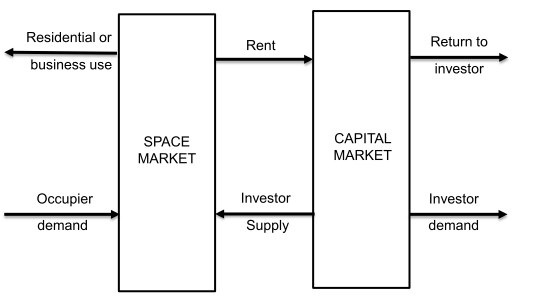
Real Estate – Space Market
- Rents are determined by the property features in the space market:
- The market for usage (or the right to use) real property (land and built space)
- Also referred to as the rental market
- Reconciles occupier demand with investor supply
- Occupier demand can be very sensitive to the features of each property
- is there enough of a market to pay the rent? If no demand, how does the investor make more money
- Often less insensitive to changes in rent
- Demand side – individuals, households, and firms that want space for consumption or production purposes i.e. student renting an apartment, law firm renting office space
- Supply side – real estate owners who rent space to tenants. i.e. shopping centre owners letting space to retailers
- NOTE: own space and want to use it
Real Estate – Capital Market
- Investment decisions are made in the capital market:
- Investors can use their own and borrowed capital to earn a rate of return from rented properties, depending on alternative investments and interest rates on borrowings.
- The asset market/ property market is the market for financial ownership of real estate assets
- Assets consist of claims to future cash flows (rent).
- leases - income side. Freehold and fee simple - capital side. May have a lease which may have great income but is detrimental to capital growth - lock in for a period of time.
- Property competes with other forms of capital assets such as stocks and bonds for the allocation of capital
- NOTE: is the ROI and ROE worth putting the capital there? own capital or equity?
Space market and capital market
The capital and space markets are driven by different factors but are linked by their rents:
Three key features of income producing (investment) properties:
- Location
- Buildings
- Tenants
Location
- At the city or regional level, the elements of the location to investigate are the strength of the economic base and demographic features
- Suburb level - occupants will pay more to be amongst compatible, safe and prestigious buildings
- A good location has an element of monopoly, cannot be replicated elsewhere
- Can effect your asset - proximity to infrastructure, labour, markets.
- "Prime" locations have more stable demand an lower vacancy risk than fringe or emerging location
- use more likely to generate a revenue, and more revenue
- Zoning and town planning controls can add potential to a property
- more useable, and adaptable
Buildings:
- To produce a secure, growing income, buildings should be functional for current users and be adaptable to the changing needs of future occupants.
- What is the likelihood that the uses will grow over time?
- Needs of residential tenants will vary slightly overtime - norms and fashions change
- Needs of business tenants change through use of technology to meet needs of customers (manufacturing, provision of services, retail)
- Demand tends to be 'price inelastic'
- Tenants will choose a building based on family/business requirements that are not sensitive to modest changes in rent
- Tenants needs change over time - buildings may become obsolete over time and no longer attract tenants of a certain calibre
- Environmental sustainability affects rental properties:
- Buildings that waste energy are more expensive to operate = lower net operating income to investors
- Tenants are now demanding high standards of energy efficiency and assurances of healthy working conditions in the buildings they lease
- Government funding may be available to make existing buildings more efficient e.g. solar hot water grants
Tenants
-
Rent is paid in accordance with the lease terms provided that the tenant can afford the payments.
-
Leases provide a degree of certainty to the income stream for the investor.
-
Could be compared to a bond or debt instrument - contractual obligation for payment
-
Non renewal of lease may lead to vacancy or expensive leasing incentives to attract new tenants
-
Lease clauses:
- Lease length
- Basis of rent review: fixed, indexed, ratchet, cap, collar
- Responsibilities - opex, maintenance
- How do you review the rent? Generally there is a mechanism for the rent ot go up. referable to CPI? ratchet (only can go up). Cap/collar - can't go +-10% every three year review
- Responsibilities: income stream from sole trader vs multinational is greater, but generally more difficult to deal with
-
Tenants:
- Financial strength - risks around rent payment
- Potential growth - rental growth, space requirements
- Potential vacancy - risk of vacancy due to default or end of lease
-
NOTE: when owning an investment property, have to gauge how long it will be vacant for
RISK MANAGEMENT
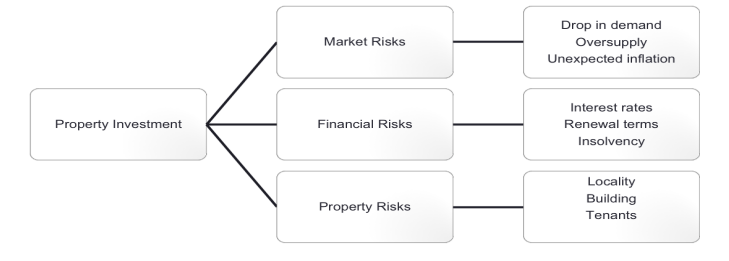
Sources of risk
Market Risks:
- Affect almost all properties in the submarket, but often to a different degrees
- Partial protection from long term leases - rents with fixed or CPI increases
- Risks from market imbalances can arise form:
- Changes in supply - overbuilding
- Overconfidence in investors or lenders- lower yields and unstable prices
- Changes in demand for goods and services which dominate the regional economy
- Results:
- Declining rents
- High vacancies
- Rising yields
Financial Risk
- Arise from the financing of the property. Typically financial risks augment other risks and are the main reason property investments may become "insolvent". Risks:
- Volatility associated with leverage
- Costs of loan default
- Interest rate increases
- Inability to refinance expiring loans
Challenge of real estate risk - refinance a loan
- don't get a 25 year loan. If you are unlucky, you have not been able to refinance an expiring loan
- bank may default it