Lecture 3
- Exam will only cover the first four weeks of content
Outline
- Risk Management (continued from last week)
- Indirect Ownership Structures
- REITs
- LPTs
- PPPs
- JVs, partnerships, clubs etc
- Modern Portfolio Theory Overview
- Acquisition and Disposal Process
Risk Management
- What is Risk?
- The extent to which an actual outcome is adverse and differs from the expected/predicted outcome
- The probability of the adverse outcome occurring
- NOTE: expect x to happen, what is the likelihood of y happening
- What is a mitigated vs unmitigated risk, and find out how much it costs to mitigate the risk
- Include an opportunity register, contract more for xy etc.
- Risks costs were offset against opportunities you might have
- Risks vs Issues
- Risks are potential adverse outcomes
- Issues are actual adverse outcomes
- NOTE: people often confuse them in projects
- Manage risks and issues differently; risks you monitor, issues you have to put an action in place to manage it.
- Risks aren't real until they become an issue. Risks are potential issues that have a probability of becoming an issue that are used to allocate a costs, but they are not issues.
- Challenge: properly evaluated the risk and pass on many opportunities
- Good property developers don't price the risks originally, and miss many 'potential' risks that never become an issue.
- How do you individually manage all your risks?
- Risk vs Returns
- The greater the degree of risk should correspond with a greater expected return
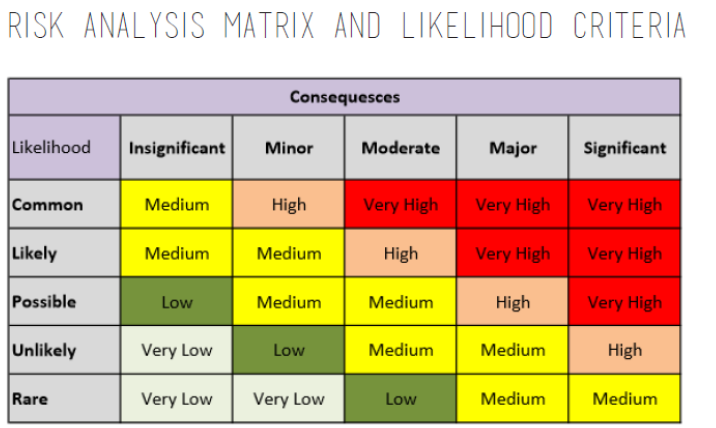
- Worst risk that can happen is someone dying
- when evaluating a project, which risks do you escalate, mitigate, etc?
- e.g. anything medium or below we just monitor
Financial Risks
- Systematic Risk (beta):
- Variance attributable to the market and influences all assets.
- Example: RBA changes interest rates
- Cannot be diversified away.
- Unsystematic Risk:
- Is asset / firm specific risk and unrelated to the market.
- Example: Balance sheet changes in a firm or vacancy in property asset due to a tenant restructure.
- Diversification is key for the protection against unsystematic risk
Property Risk
- Risks that affect the property investment but not the market as a whole. May damage location, buildings and tenants.
Risks:
- location rental and capital value impacts: trading potential of a retail store impacted by reduced pedestrian access
- Building failure- unexpected running costs, claims against owners allowing contaminating uses etc
- Soundness or 'covenant' of a tenant - checks on financial stability of a tenant prior to purchasing a property
- Many building risks can be insured against
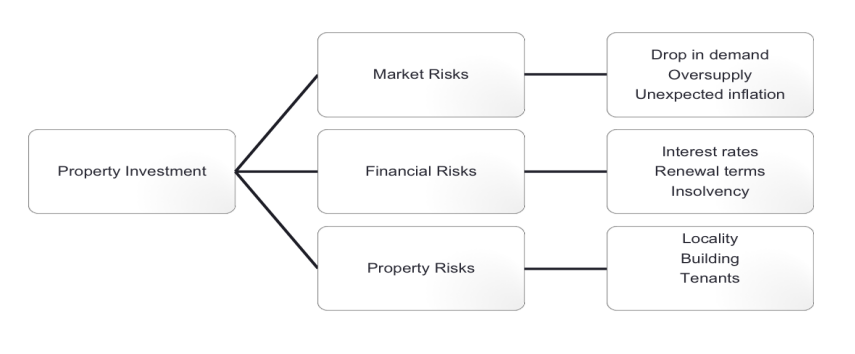
Other major risks impacting property ownership:
Business Risk
- Business risks due to fluctuations in economic activity that affect the variability of income produced by the property.
- Properties with well-diversified tenant mixes are less subject to business risk
Financial Risk
- Use of debt financing magnifies business risk.
- Degree of financial risk increases as the amount of debt increases and depends on the cost and structure of debt
Liquidity Risk
- Occurs when a continuous market with many buyers and sellers and frequent transactions is not available. The more difficult an investment is to liquidate, the greater the risk that a price concession may have to be given to a buyer should the seller have to dispose of the asset quickly.
- NOTE: Not just a problem which is limited to property
Management Risk
- Most investments rely on management to keep space let and maintained.
- The rate of return that the investor earns can depend on the competency of the management
- NOTE: the quality of the management will directly impact its performance and potential litigation and liabilities
- e.g. outsourced the management of supermarket to a bad management company and the property is never cleaned, more susceptible to TP accidents, e.g.
Interest Rate Risk
- Changes in interest rates will affect the price of all securities and investments.
- Real estate tends to be highly levered, thus, rate of return earned by equity investors can be affected by changes in interest rates.
- rates go up, property prices go back
- Residential real estate is opposing this trend - should have stabilised -> supply not keeping uop with demand
Legislative Risk
- Real estate is subject to numerous regulations such as tax laws, rent control, zoning and other restrictions imposed by government.
- Changes in legislation can adversely affect the profitability of an investment - especially for new development.
- NOTE: legislation impacts property, zoning, environmental heritage. Dealing with three layers of government
- State reserves rights with respect to property law
- Local government have delegated the laws of town planning
- Council makes decisions about planning that impacts peoples lives
Environmental Risk
- Value of real estate is often affected by changes in the environment or sudden awareness that the existing environment is potentially hazardous. E.g. Asbestos
- NOTE: clean up costs with contamination
- Environmental risk can cause more of a loss than other risks mentioned because the investor can be subject to clean-up costs that far exceed the property value.
- NOTE: is there an excessively large 'environmental risk' e.g.
Inflation Risk
- Unexpected inflation can affect an investors expected rate of return if the income of the property does not increase sufficiently to offset the impact of inflation.
INDIRECT OWNERSHIP STRUCTURES
| Retail | Wholesale |
|---|---|
| - Suitable for institutional and “mum and dad” style investors - Minimum investment for syndicates generally $5,000+ | - Designed for large scale sophisticated investors - Investors must qualify under Corporations Act - Minimum Fund investment $500,000+ |

Investor types: Wholesale
Wholesale Investor Types:
- Sophisticated investor:
- Deemed to have sufficient investing experience and knowledge to weigh the risks and merits of an investment opportunity.
- Net assets of at least $2.5m or;
- Gross income for each of last two financial of at least $250,000
- Deemed to have sufficient investing experience and knowledge to weigh the risks and merits of an investment opportunity.
- Professional Investor:
- Australian financial services licensee;
- A body regulated by APRA outside of Superannuation;
- A body registered under the Financial Corporations Act 1974
- Trustees of superannuation funds with assets >$10m
NOTE:
- good projects are fully subscribed or offered to wholesale investors before retail investors
- retail investors tend to get the 'dregs' of bad investment
Wholesale Funds: Overview:
- vehicles set up for acquiring 1 or more properties
- normally sector specific
- gearing - the amount of leverage. Typical low and spread across a variety of assets
| No. of Investors | Typically 20 - 50 investors for Funds |
|---|---|
| Minimum Investment | $500,000 upwards |
| Diversification | Usually 10+ assets - Sector specific or diversified across assets |
| Term | Generally open ended |
| Gearing | 0% to 30% for ‘Core’ Funds e.g. Target gearing of 15% to 25% with a maximum of 40% |
-
Institutional investors make investments to wholesale funds based on a view that unlisted private equity format accurately represents the true returns of the underlying real estate assets
-
Wholesale unlisted property trusts are aimed at institutional investors
- Predominantly AU superannuation funds or foreign pension and sovereign wealth funds
- May include Ultra High Net Worth Individuals
-
Each trust tends to have a specific strategy or mandate to invest within a particular sub sector of the real estate market and takes two forms:
- Open-ended vehicles:
- No fixed life, target ‘core’ real estate assets across industrial, retail and office sectors
- Closed-end fixed-life vehicles:
- Invest in higher risk real estate
- Involves value-add opportunities or development projects
- Within life, get these assets and distribute back after 5 years e.g.
- Open-ended vehicles:
Clubs/Mandates
| Info | Description |
|---|---|
| No. of Investors Clubs: | Less than 5 investors - Mandates: Generally 1 investor |
| Typical Investor | Large Super Funds - Insurance Companies - International Institutions |
| Minimum Investment | $50 million upwards |
| Diversification | Usually 5+ Assets - generally target a specific strategy |
| Term | Opportunity specific |
| Gearing | Opportunity Specific |
- Clubs and segregated mandates becoming more popular
- Investors:
- Tend to be large domestic superannuation funds
- Sovereign wealth funds
- International institutions
- Most vehicles no or low gearing
- Particular strategy, particular risk profile ie. Mandate
- Reasons for growth
- Larger investors favour a more hands on approach with asset managers
- Investors are becoming more sophisticated and are looking for specialist skills in asset classes and geographies
- Ability to gain tailored exposure to specific asset classes
NOTES:
- e.g. selling the national broadband network. Mandate might come together to create a management vehicle (fund) under a mandate to acquire a particular fund
- generally needs a lot of money, often no gearing
- reasons for growth, bring in people that have particular skills. Some funds want to partner with entities that have expertise
Syndicates
| Size | $5 million to $50 million |
|---|---|
| No. of Investors | Typically 100+ |
| Typical Investor | Private investors - Self managed super funds |
| Minimum Investment | $1,000 to $10,000 |
| Diversification | Varies from funds with only one asset up to 10+ assets |
| Term | Fixed term investment (typically 5 -7 years) |
| Gearing | Typically 40% to 60% |
-
Closed-end funds with a fixed life expectancy
- Further capital is not raised after initial offering
-
Target high net-worth individuals and SMSF
-
Investors hold their interest until property is sold or rolled over
-
Offer document such as a product disclosure statement (PDS)
-
Repetitive process
- Identify opportunity
- Negotiate structure and investment
- Purchase building
- Raise debt and pool investor equity
-
Individual property strategies
-
Enhanced regulatory focus in recent years
-
Recent resurgence in popularity for syndicates
-
Retail funds management industry is less consolidated
- Lower barriers to entry and wider investment base
- Difficult to identify all players due to small size of typical funds
-
NOTE: directly investing in properties without the capital hurdle
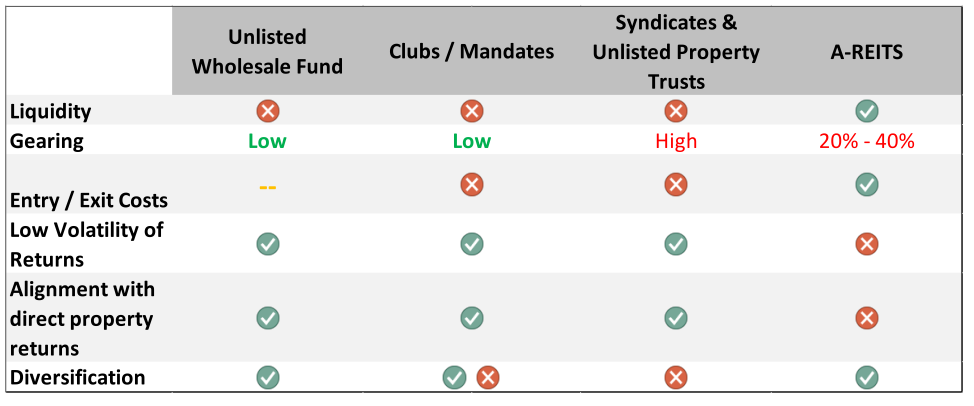
Fund investment strategies
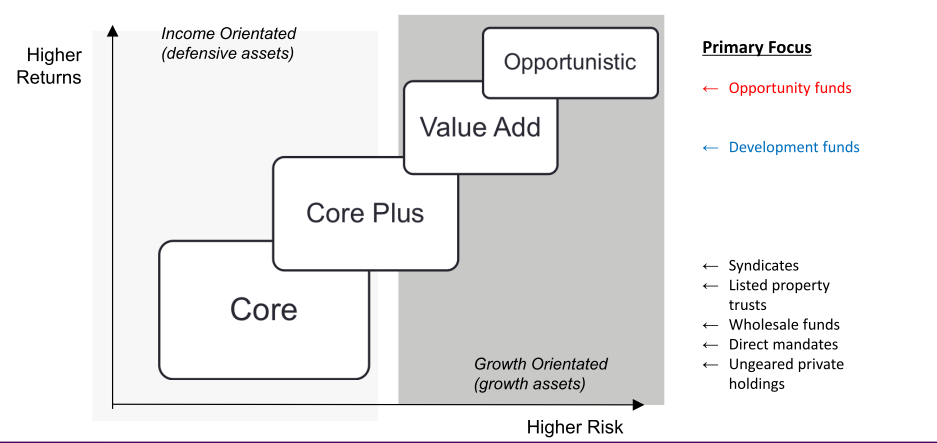
Core
- Primarily invest in:
- Stabilised existing properties
- Current cash flows
- Low vacancy
- Located in major metropolitan areas
- Invest in a wide variety of property types
- Use limited leverage - low risk
Core Plus
- Core plus properties can be a minor component of core fund:
- Core assets in need of minor improvements
- “a B property in an A location”
- Core property that includes current undeveloped land
Value Add:
- Take on more risk by purchasing properties which:
- Carry current vacancies
- Have upcoming major tenant rollovers
- In need of renovation and capital outlay
- Funds create value by renovating and leasing up the property
- Use more leverage compared to core plus
Opportunistic
- Take on even more risk by doing ground up development projects
- Expose the fund to additional construction risks:
- Entitlements
- Construction delays
- Cost overruns
- Complex JV management issues, etc.
- High degree of financial leverage
- May be less diversified and concentrate in certain geographic areas or property types
- Strategy may involve purchasing “distressed property assets”
NOTE:
- not diversified, because you mitigate legislative and planning risk because you have to make sure what you build on there makes a massive profit
- pick a market, council, state, etc.
Investment management fees
-
Fees charged by fund managers generally fall into one/more of the following categories:
-
Acquisition fees charged when each property is acquires and typically a percent of the acquisition cost
-
Disposition fees charged when asset is sold.
-
Performance fees paid as an added incentive to enhance fund performance
- Based on the extend to which the fund managers return exceeds a “hurdle rate of return”
- Typically paid to fund managers to compensate them for taking on additional risks in development or repositioning properties
- Performance fees disappearing from the Wholesale ‘Core’ landscape
-
Management fees:
- Charged to the investor for the entire term of the fund
- Core funds charge base fees on equity capital
- Generally expressed annually as a percentage or basis points (bps)
-
Management fees may be calculated on:
- Committed capital or invested capital
- A percentage of cash flow distributions
- Project Revenues
- Project costs
-
NOTE: property management is very admin intensive
-
fund manager will want more performance fees if exceeds expected performance of the asset
A-REIT
- A Real Estate Investment Trust (REIT) is an investment vehicle that allows investors to purchase an interest in a diversified and professionally managed portfolio of real estate that is listed on the stock exchange.
- A-REITS or Listed Property Trusts (LPT) make up one of the largest sectors on the Australian Stock Market
- A-REITs were established to allow investors to gain exposure to high-grade real estate both domestically and offshore, without the need for large levels of capital, and with the addition of liquidity.
Generates wealth in two ways:
-
They provide exposure to the value of the real estate assets that the trust owns and the accompanying capital growth,
-
as well as rental income.
-
The fund manager selects the investment properties and is responsible for all administration, improvements, maintenance and rental.
-
Some A-REITs specialise in particular sectors, and usually fall into one of the following categories:
- Industrial trusts invest in warehouses, factories, and industrial parks
- Office trusts include medium- to large- scale office buildings in and around major cities
- Hotel and leisure trusts invest in hotels, cinemas and theme parks
- Retail trusts invest in shopping centres and similar assets
- Diversified trusts invest in a mixture of industrial, offices, hotels and retail property.
NOTE
- all day-to-day running of the property
- tend to be sectorised
Why invest in REITS?
- A-REITs have been the preferred property asset class for retail investors and some wholesale investors over direct property.
- The key benefits of investing in A-REITs are:
- Exposure to high quality assets
- Diversification - geographic, sector etc
- High yielding
- Liquidity
- Management efficiency and quality
- Low transaction costs (no stamp duty)
- Corporate governance
- On the negative side – volatility, fee leakage.
NOTES:
- Able to review the efficiency, effectiveness and performance of the management company, lot of information about their costs, how they performed in the past
- low transaction costs - easy to get in and out. If listed, under all the asx rules
- negatives: profit in capital growth or income bled through fees
- Volatility - management is not performing well and you unit is losing value as a result
Fund From Operation (FFO)
There are 5 ways a REIT can grow income and increase funds from operations:
- Growing income from existing properties
- Renting more space
- Raising rent
- Redevelopment
- Growing income through acquisitions
- Growing income through development
- Growing incomes through provision of services
- Financial engineering
- refinancing and allocate resources and capital
REIT characteristics
- Legal Form
- No specific REIT rules in Australia - can be listed or unlisted
- May be sector specific or diversified
- Corporations Act states a REIT must be registered as a Managed Investment Scheme
- No specific REIT rules in Australia - can be listed or unlisted
- Capital Requirements
- No capital requirements for a REIT if listed (but must meet ASX requirements)
- Capital requirements for a manager
- Listing Requirements
- No listing requirements – REITs can be listed or unlisted
- Restrictions on investors
- No investment restrictions on investors
- Restrictions on foreign assets
- No restrictions on foreign assets
- Distribution requirements
- Undistributed income on gains taxed at 46.5%
- gains are taxed at your prevailing personal tax rate
- Full distribution of income and gains by REITS generally occurs
- Undistributed income on gains taxed at 46.5%
REIT Distributions
- Trusts distribute 90% to 100% of earnings
- AREIT trusts do not have franking credits – income is not taxed at trust
- Distributions taxed at the individual income tax rate
- REIT distribution includes a tax deferred component
- Tax deferred component – represents the return of capital rather than income
- Plant and equipment depreciate which reduces taxable income - can be distributed to beneficiaries of the REIT - can get some of the capital back too
- As REITs collect income – manager can decide if the payments made to investor are income collected or capital invested
A-REIT forms
- Broadly speaking, A-REITs comprise one of two forms:
- Externally Managed (passive); or
- Stapled (active).
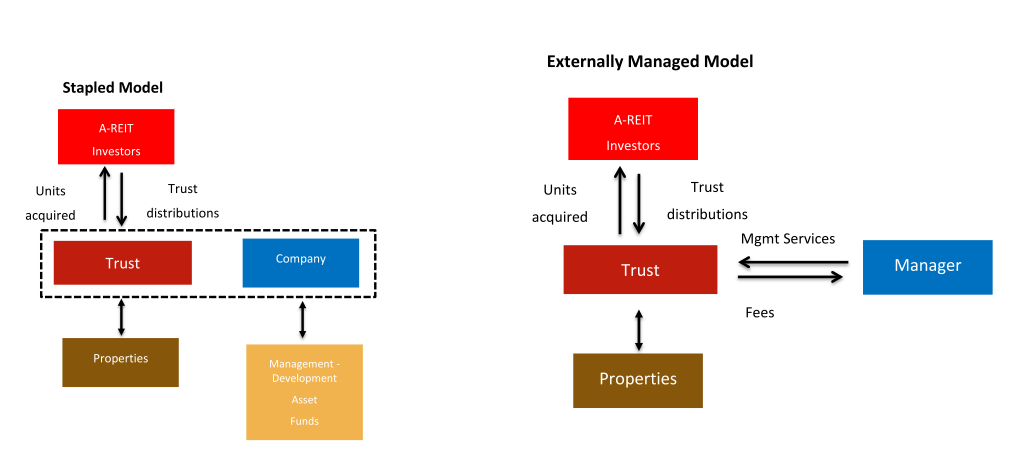
RHS:
- investors put money into the trust
- trustees purchase properties and hire a manager
- entity managing the property is not necessarily the same as the trustee that owns the property
LHS:
- unit holder holds shares in the trust and the management company
- have an equity position in the company also
- unit in the trust, and shares in the management company
- most common
Stapled securities
- Some trusts adopt hybrid structures called ‘stapled securities’ funds.
- Stapled securities A-REITs provide investors with exposure to a funds management and/or a property development company, as well as a real estate portfolio.
- A share in a stapled securities fund usually consists of one trust unit and one share in the funds management company.
- These securities are ‘stapled’ and cannot be traded separately.
- The trust holds the portfolio of assets, while the related company carries out the fund’s management functions and/or manages any development opportunities.
Externally Managed model:
- Management taken on by separate entity to the property trust
- Slowly collapsing over time
- Often conflicts of interest between management and trust
- Can provide better resourcing and management services than some REITs have capacity for
MODERN PORTFOLIO THEORY
- For many investors income properties are just one part of an investment portfolio:
- May include other properties or asset classes (shares, interest bearing securities)
- The key is that the risk of a property as an isolated investment is greater than the risk the property adds to a portfolio.
- Modern portfolio theory (MPT) has become a well-accepted framework to construct or rebalance real estate portfolios
- MPT assumes investors are risk-averse
- Given two assets offer the same expected return, investors will prefer the less risky one
- Investors will accept increased risk if compensated by higher expected returns
NOTE:
- balancing real estate portfolios
- assets with different risks and returns, when aggregating them you are overall mitigating aggregate risk
- By balancing multiple assets with different risk profiles, you overall have a better risk portfolio and better risk management
Asset Returns
- Total (Accumulation) Return accounts for two categories of return: income and capital
- Income includes interest paid by fixed-income investments, distributions dividends or the net income of direct property
- Capital/ Price return represents the change in the market price of an asset.
- income and capital
- Initial Yield
- The income yield for the asset. Shows the ratio of the current passing rent to the current property value
- IY = passing rent / property value
- passing yield - how much rent I am currently versus from the current property value
- The income yield for the asset. Shows the ratio of the current passing rent to the current property value
- Reversionary Yield
- The market yield for the asset. Shows the ratio of the market rent to the current property value (on properties rented below market)
- RY = market rent / property value
- what is the market rent of the property value
- reversionary - at the end of the lease term, the right to possess the property reverts back to the owner
- in a perfect world, initial yield and reversionary yield is the same
Income return
A property is valued at $2.5m and has a current net income of $150,000 p.a. The assessed market income for the property is $175,000 p.a. Compute the initial yield and reversionary yield for the asset.
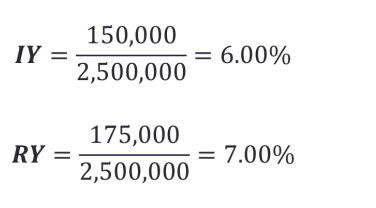
Capital Return
The change in capital value of an investment over a holding period as a percentage between any change in capital value and the purchase price or value at the beginning of the measurement period.
Capital Return=
Income Return
- Net income over the measurement period divided by the purchase price or capital value at the beginning of the measurement period.
Income return =
Total Return
Percentage relationship between any capital gain or loss and income over the capital value at the beginning of the measurement period.
- True return to the investor on their money.
Total return =
CV = capital value at the beginning of the measurement period CV1 = capital value at end of the measurement period NI = net income received during the period
- Over time, land tends to appreciate while building depreciate
- If the majority of the value is attributed to the build component, over time the future capital value will be a small part of it increasing the land and a large part decreasing the value
- common to have small income (and small building) but large capital component or other way around
Asset Yields vs Asset Returns
- Yield reflects the relationship between a current net income and the purchase price and does not take into account any capital loss or gain made.
- Return usually reflects any income, expenditure and/or capital gain or loss made on investments.
- Return gives a clear indication of the financial position of the investor.
- Yields are used to estimate the market value of an investment while a return is used as a means of comparing the financial attractiveness of different investments to an investor.
Portfolio returns
- Return is a weighted average of expected return on each asset.
- Consider two assets with weights, w 1 w 2 and returns r 1 r 2 .
Portfolio return:
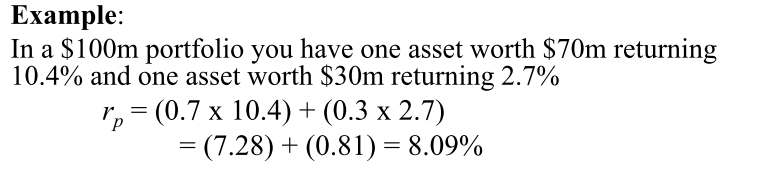
Acquisition and Disposal process
-
Direct or indirect ownership decision
-
Timing – what stage of the property cycle do you buy into?
-
Asset physical characteristics
- Segment
- Size
- Location
- Age and condition of improvements
-
Financial characteristics
- Hurdle rate for return on investment/return on capital
- WALE (weighted average lease expiry)
- Income and capital growth opportunities
-
process purchasing every kind of infrastructure, e.g.
-
timing - hot market, buying/selling market will impact due diligent time frames etc.
-
WALE - 100 leases expiry at the end of year, WALE is one year. Average the lease expiry
- can also weight based on income too, or how much space is becoming available
Acquisition Process
Typical Expression of Interest process (can be over 12 months)
- Initial Review of an Asset
- Engage Consultants
- First Round Bids
- Second Round Bids
- Third Round Bids
- Due Diligence
- Contract Signing
- Settlement
- normal process to acquire a project
- 12 months is not an unusual EOI
- Initial Review of an Asset
- Meet with agents to discuss opportunity
- Review of Information Memorandum
- Initial Pricing of Asset based on Financial Pack - Budget, Outgoings recovery model, Tenancy Schedule
- Initial review of documents provided in data room
- Multiple pricing scenarios and sensitivity analysis
- not uncommon to pay $50-150K for an unsuccessful property purchase
- Engage Consultants
- Usually only applicable in complicated transactions such as large scale retail for a market / trade area analysis
- First Round Bids
- Submission of First Round Bids to Agents
- Includes price and terms
- i.e. $80,500,000, subject to FIRB Approval, subject to Board Approval, 60 day settlement, subject to Due Diligence period of 4 weeks etc etc
- NOTE: look at them, how compliant are they to community objective, etc. Aligns to policy objective to what the seller has outlined
- Second Round Bids
- Shortlisted parties (usually 3) are invited to provide a second round bid
- Usually a higher/ more competitive bid based on sensitivity analysis, market assessment undertaken throughout first round bids and assumption clarification
- 3rd Round Bids (BAFO – Best and Final Offer)
- Only applicable in very competitive markets
- Not always applicable in the bid process - subject to vendor and agent’s preference
- Due Diligence
- Often 4 - 6 weeks
- Hot / competitive market is reducing DD periods to 4 weeks or less
- Some transactions in the market have taken place with no DD
- Allows for detailed analysis of financial, technical and legal review of the asset
- Contract Signing
- Property sale contract signed by all parties
- Settlement
- Settlement varies dependent on vendor and purchaser preferences
- Often 30 - 60 days
- Can be as long as 6 months
Typical Due Diligence Checklist
- Rent Roll Analysis
- Lease Agreement Review
- Review of Service and Maintenance Agreements
- Pending or threatened matters review
- Review of Title/deed documents
- Property Survey
- Government Compliance
- Physical Inspection
- Tax Matters
- Insurance Policies
- Engineering studies
- Market studies
- List of personal property
Divestment Criteria
- Reposition of Fund
- Too much retail in a Fund benchmarked against diversified assets. i.e. high capital returns in funds invested in Sydney/ Melbourne office markets have increased the return benchmark for funds that might carry too much retail (lower total returns compared to certain office markets)
- Cyclical Play - i.e. Office Market - buy low, sell high
- Closed end Fund
- requires divestment of assets at the end of the Fund
- Capital Requirements
- Liquidity windows and unit redemption may force sale of assets
- sell assets to offset leverage
- Liquidity windows and unit redemption may force sale of assets
Disposal Process
- Internal Approvals
- Internal Board and Investment Advisory Committee Approvals
- Data Collection
- Collection of all documents relating to the asset
- Leases, management agreements, service contracts, maintenance records, tenant tax invoices, dispute notices
- Internal Valuation of the Asset
- Multiple pricing scenarios to target marketing date, use for recommendation of divestment.
- Due Diligence
- Validation of all documents related to asset
- Can be 2,000 - 3,000 documents requiring validation
- Agency Appointment
- Agency submissions and appointment of successful agent
- Agent’s domestic and international reach taken into consideration as well as fees
- One or two agents dependant on size of transaction
- Launch Campaign
- International campaign typically 1-2 weeks ahead of domestic campaign
- Campaign length typically 4 weeks domestically
- Bid Submissions
- Bid submissions taken and parties shortlisted
- Second Round Bids
- Shortlisted parties invited to submit second round bids
- Parties shortlisted dependant on bid price, terms, perceived settlement risk
- Due Diligence
- Contract Signing
- Settlement
- data rooms, partially redact data and can see what data the other entity has accessed