Lecture 3 Revision - Important Concepts
Real Estate Ownership Structures Pt2
INDIRECT OWNERSHIP STRUCTURES
| Retail | Wholesale |
|---|---|
| - Suitable for institutional and “mum and dad” style investors - Minimum investment for syndicates generally $5,000+ | - Designed for large scale sophisticated investors - Investors must qualify under Corporations Act - Minimum Fund investment $500,000+ |

Investor types: Wholesale
Wholesale Investor Types:
- Sophisticated investor:
- Deemed to have sufficient investing experience and knowledge to weigh the risks and merits of an investment opportunity.
- Net assets of at least $2.5m or;
- Gross income for each of last two financial of at least $250,000
- Deemed to have sufficient investing experience and knowledge to weigh the risks and merits of an investment opportunity.
- Professional Investor:
- Australian financial services licensee;
- A body regulated by APRA outside of Superannuation;
- A body registered under the Financial Corporations Act 1974
- Trustees of superannuation funds with assets >$10m
Wholesale Funds: Overview:
| No. of Investors | Typically 20 - 50 investors for Funds |
|---|---|
| Minimum Investment | $500,000 upwards |
| Diversification | Usually 10+ assets - Sector specific or diversified across assets |
| Term | Generally open ended |
| Gearing | 0% to 30% for ‘Core’ Funds e.g. Target gearing of 15% to 25% with a maximum of 40% |
- Institutional investors make investments to wholesale funds based on a view that unlisted private equity format accurately represents the true returns of the underlying real estate assets
- Wholesale unlisted property trusts are aimed at institutional investors
- Predominantly AU superannuation funds or foreign pension and sovereign wealth funds
- May include Ultra High Net Worth Individuals
Clubs/Mandates
| Info | Description |
|---|---|
| No. of Investors Clubs: | Less than 5 investors - Mandates: Generally 1 investor |
| Typical Investor | Large Super Funds - Insurance Companies - International Institutions |
| Minimum Investment | $50 million upwards |
| Diversification | Usually 5+ Assets - generally target a specific strategy |
| Term | Opportunity specific |
| Gearing | Opportunity Specific |
- e.g. selling the national broadband network. Mandate might come together to create a management vehicle (fund) under a mandate to acquire a particular fund
- Bring in people that have particular skills. Some funds want to partner with entities that have expertise
Syndicates
| Size | $5 million to $50 million |
|---|---|
| No. of Investors | Typically 100+ |
| Typical Investor | Private investors - Self managed super funds |
| Minimum Investment | $1,000 to $10,000 |
| Diversification | Varies from funds with only one asset up to 10+ assets |
| Term | Fixed term investment (typically 5 -7 years) |
| Gearing | Typically 40% to 60% |
Fund investment strategies
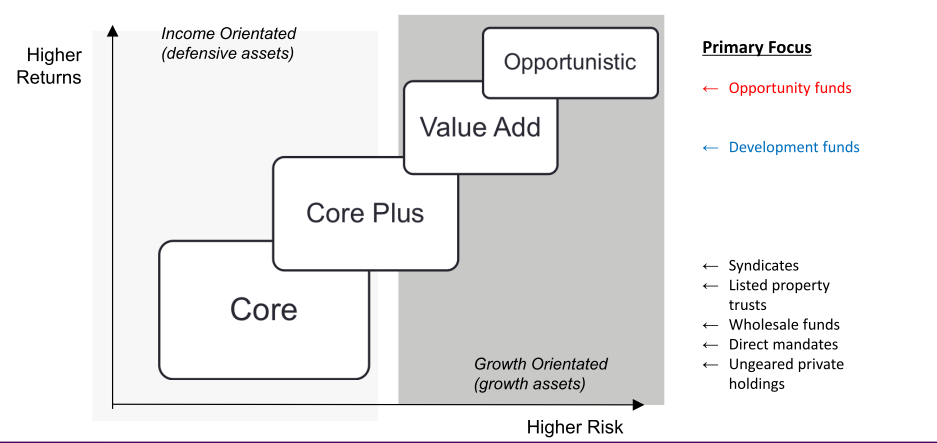
Core
- Primarily invest in:
- Stabilised existing properties
- Current cash flows
- Low vacancy
- Located in major metropolitan areas
- Invest in a wide variety of property types
- Use limited leverage - low risk
Core Plus
- Core plus properties can be a minor component of core fund:
- Core assets in need of minor improvements
- “a B property in an A location”
- Core property that includes current undeveloped land
Value Add:
- Take on more risk by purchasing properties which:
- Carry current vacancies
- Have upcoming major tenant rollovers
- In need of renovation and capital outlay
- Funds create value by renovating and leasing up the property
- Use more leverage compared to core plus
Opportunistic
- Take on even more risk by doing ground up development projects
- Expose the fund to additional construction risks:
- Entitlements
- Construction delays
- Cost overruns
- Complex JV management issues, etc.
- High degree of financial leverage
- May be less diversified and concentrate in certain geographic areas or property types
- Strategy may involve purchasing “distressed property assets”
A-REIT
- A Real Estate Investment Trust (REIT) is an investment vehicle that allows investors to purchase an interest in a diversified and professionally managed portfolio of real estate that is listed on the stock exchange.
- A-REITs were established to allow investors to gain exposure to high-grade real estate both domestically and offshore, without the need for large levels of capital, and with the addition of liquidity.
REIT characteristics
- Legal Form
- No specific REIT rules in Australia - can be listed or unlisted
- May be sector specific or diversified
- Corporations Act states a REIT must be registered as a Managed Investment Scheme
- No specific REIT rules in Australia - can be listed or unlisted
- Capital Requirements
- No capital requirements for a REIT if listed (but must meet ASX requirements)
- Capital requirements for a manager
- Listing Requirements
- No listing requirements – REITs can be listed or unlisted
- Restrictions on investors
- No investment restrictions on investors
- Restrictions on foreign assets
- No restrictions on foreign assets
- Distribution requirements
- Undistributed income on gains taxed at 46.5%
- gains are taxed at your prevailing personal tax rate
- Full distribution of income and gains by REITS generally occurs
- Undistributed income on gains taxed at 46.5%
REIT Distributions
- Trusts distribute 90% to 100% of earnings
- AREIT trusts do not have franking credits – income is not taxed at trust
- Distributions taxed at the individual income tax rate
- REIT distribution includes a tax deferred component
- Tax deferred component – represents the return of capital rather than income
- Plant and equipment depreciate which reduces taxable income - can be distributed to beneficiaries of the REIT - can get some of the capital back too
- As REITs collect income – manager can decide if the payments made to investor are income collected or capital invested
A-REIT forms
- Broadly speaking, A-REITs comprise one of two forms:
- Externally Managed (passive); or
- Stapled (active).
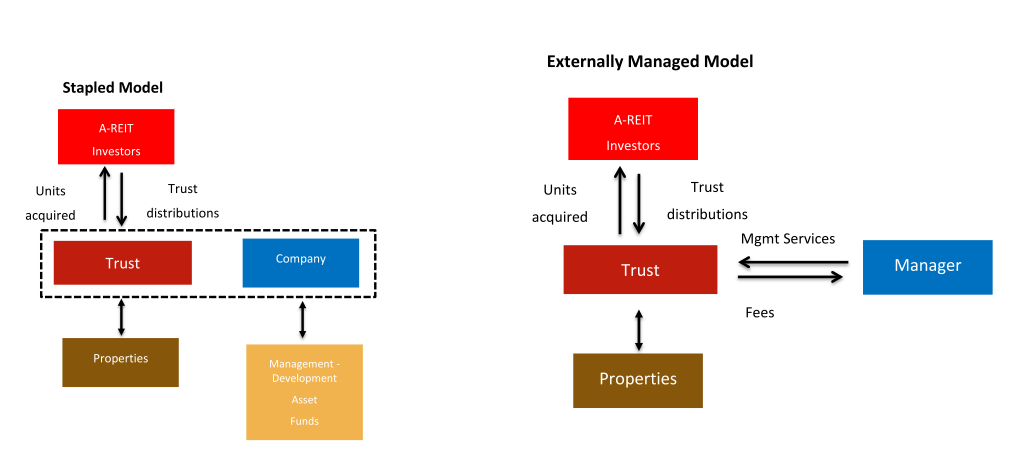
RHS:
- investors put money into the trust
- trustees purchase properties and hire a manager
- entity managing the property is not necessarily the same as the trustee that owns the property
LHS:
- unit holder holds shares in the trust and the management company
- have an equity position in the company also
- unit in the trust, and shares in the management company
- most common
Stapled securities
- Some trusts adopt hybrid structures called ‘stapled securities’ funds.
- Stapled securities A-REITs provide investors with exposure to a funds management and/or a property development company, as well as a real estate portfolio.
- A share in a stapled securities fund usually consists of one trust unit and one share in the funds management company.
- These securities are ‘stapled’ and cannot be traded separately.
- The trust holds the portfolio of assets, while the related company carries out the fund’s management functions and/or manages any development opportunities.
Externally Managed model:
- Management taken on by separate entity to the property trust
- Slowly collapsing over time
- Often conflicts of interest between management and trust
- Can provide better resourcing and management services than some REITs have capacity for
Modern Portfolio Theory
Capital Return
The change in capital value of an investment over a holding period as a percentage between any change in capital value and the purchase price or value at the beginning of the measurement period.
Capital Return=
Income Return
- Net income over the measurement period divided by the purchase price or capital value at the beginning of the measurement period.
Income return =
Total Return
Percentage relationship between any capital gain or loss and income over the capital value at the beginning of the measurement period.
- True return to the investor on their money.
Total return =
CV = capital value at the beginning of the measurement period CV1 = capital value at end of the measurement period NI = net income received during the period
Initial Yield and Reversionary Yield
Initial Yield
- The income yield for the asset. Shows the ratio of the current passing rent to the current property value
- IY = passing rent / property value
- passing yield - how much rent I am currently versus from the current property value
Reversionary Yield
- The market yield for the asset. Shows the ratio of the market rent to the current property value (on properties rented below market)
- RY = market rent / property value
Example A property is valued at $2.5m and has a current net income of $150,000 p.a. The assessed market income for the property is $175,000 p.a. Compute the initial yield and reversionary yield for the asset.
Asset Yields vs Asset Returns
- Yield reflects the relationship between a current net income and the purchase price and does not take into account any capital loss or gain made.
- Return usually reflects any income, expenditure and/or capital gain or loss made on investments.
- Return gives a clear indication of the financial position of the investor.
- Yields are used to estimate the market value of an investment while a return is used as a means of comparing the financial attractiveness of different investments to an investor.
Portfolio returns
- Return is a weighted average of expected return on each asset.
- Consider two assets with weights, w 1 w 2 and returns r 1 r 2 .
Portfolio return: