Lecture 5 Revision - Important Concepts
Valuation methodologies
The Lessor:
- The lessor has a right to receive rental and other income from the property under the terms of the lease. Once the lease has expired, the property reverts to the full control of the lessor who can then relet the property at the prevailing full market rental rates.
- The income derived from the lease can be capitalised to establish the value of the based on the lease term.
- The potential income at lease expiry is known as the Reversionary Income which can then be capitalised in perpetuity to establish the reversionary value of the property at that time.
The Lessee
- If the property is being rented by the lessee at a rate below the market rate, there is the potential for a profit to be made on the rent:
- For example:
| Full Market Rent | $1,000 per annum |
|---|---|
| Passing Rent | $800 per annum |
| Profit Rent | = $200 per annum |
The Valuation of Varying Incomes
There are several methods available for the valuation of varying incomes
1. Term & Reversion
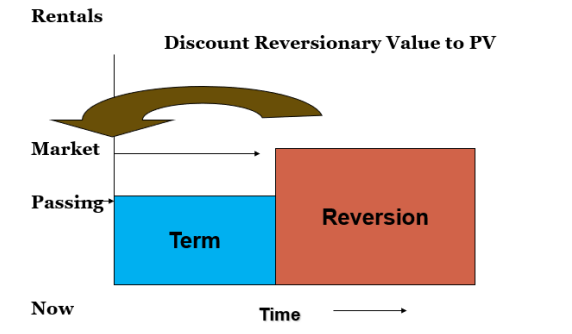
- Consider a relatively long lease term in a commercial class income producing property. The rental rates may well have been market based at the start of the lease, but over time have drifted to levels above or below market rates. This could easily happen where under the lease the rents are to be reviewed to a non -market based formula, ie to a set percentage rate or to CPI.
- This creates a problem when we need to value the freehold interest in the property. Remember, the freehold value of the property is based on the right to receive income from that property.
Example
- As an example, consider an industrial building which is now leased for 3 years at $40,000 net pa (no outgoings). The market rent is still $50,000 pa and the Cap Rate for this property is still 8%.
- In order to establish the property value subject to the lease, we need to assess the value of the lease term and then the reversionary value, and then aggregate the two.
Term Value
- To calculate the YP (period) for 3 years at 8%, we simply applied the PV of $1 pp formula for an amount of $1, to establish the factor to be applied to the annual net rent; ie.,
| 1st step (Term Value) | Value |
|---|---|
| Passing Rental | $40,000pa |
| YP (period) for 3 years at 8% | 2.5771 |
| Capital Value | $103,084 |
| 2nd step (Reversionary Value) | Value |
|---|---|
| Market Rental | $50,000 |
| Cap Rate | 8% |
| CV = NI x YP | $50,000 x 100/8 |
However, this is the value as at lease expiry, 3 years in the future. We now must discount that amount back to a Present Value.
Therefore $CV =
3rd Step Add Term and Reversionary Values to arrive at the property value.
- Capital Value = $103,084 (term) + $496,125 (reversion)
- = $599,209 (Adopt $600,000)
Hard Core, or Layer Method
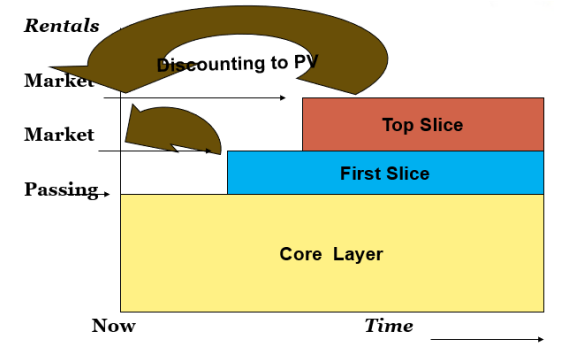
- Income under this method is treated in horizontal slices. The passing income is the “core” income which is the most secure. Rental increases achieved after future rent reviews are then additional slices (ie 2 nd slice, 3 rd slice, top slice) added later and are considered to be less secure income sources.
- Each slice is valued in perpetuity, with later slices being discounted to a present value.
- This method is useful when the property being valued has multiple tenancies.
Example
- 15 year structured lease at the following rental rates:
- 1st 5 years: $100,000 pa
- 2nd 5 years: $150,000 pa
- 3rd 5 years: $200,000 pa
- then reversion (at year 15) to Full Market Rental at $250,000 pa
- We should be able to value this income flow using the Hard Core method at a Cap Rate of 10%.
- We need to capitalise each layer in perpetuity, then bring each to a Present Value and aggregate to obtain the total value.
First step
| Layer and formula | Cost |
|---|---|
| Layer 1 | |
| CV = NI x YP | = $100,000 x 10 = $1,000,000 |
| Layer 2 | |
| CV = NI x YP | = $50,000 x 10 = $500,000 |
| Layer 3 | |
| CV = Ni x YP | = $50,000 x 10 = $500,000 |
| Layer 4 | |
| CV = NI x YP | = $50,000 X 10 = $500,000 |
Second step - Bring each of the future values back to a present value using the PV of $1 formula, or by calculator:**
| Layer | FV | Period | PV |
|---|---|---|---|
| Layer 1 | 0 | $1,000,000 | |
| Layer 2 | $500,000 | 5 yrs | $310,460 |
| Layer 3 | $500,000 | 10yrs | $192,772 |
| Layer 4 | $500,000 | 15 yrs | $119,696 |
| TOTAL VALUE | $1,622,928 |