Lecture 3
- Dig into EMH myth
- theoretical foundations
Traditional Finance vs. Behavioral Finance
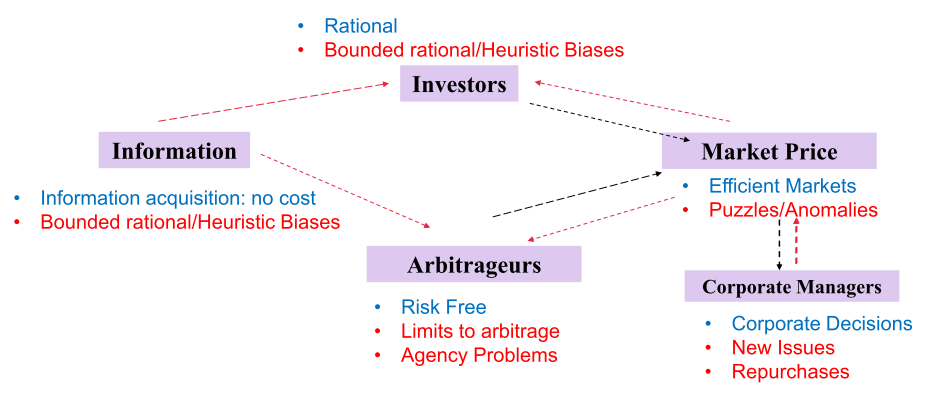
Red, behavioural perspective
blue, traditional finance
- market should be efficient
- arbitrageurs have a limit
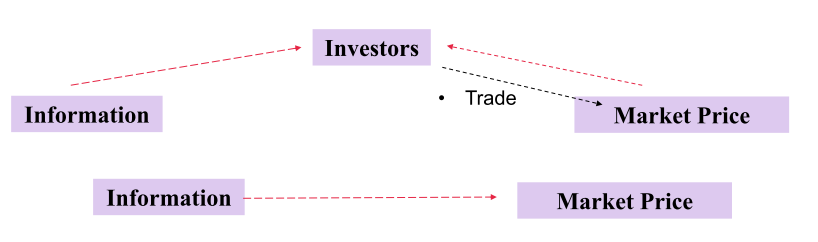
- EMH focus on information
Efficient Market Hypothesis - Overview
Only new information will move stock prices and this information is equally likely to be good news or bad news
The competition for information makes the capital market informationally efficient.
- The market processes information quickly and efficiently
- Prices reflect the information in the market.
- Market efficiency can be categorised:
- The weak form asserts that all information to be derived from past stock prices and trading volume is already reflected in stock prices.
- The semi strong form claims that all publicly available information is already reflected.
- The strong form, which generally is acknowledged to be extreme, asserts that all information, including insider information, is reflected in prices.
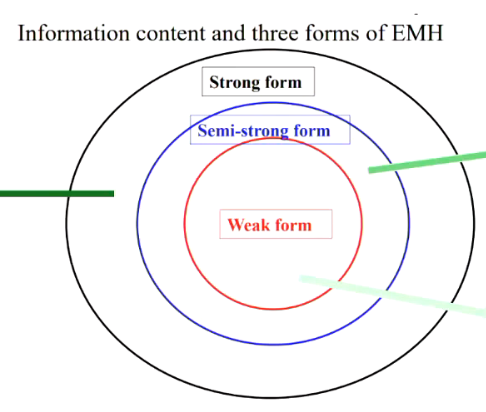
- market will react immediately and stock prices will reflect it
- Weak form - only past information
- semi-strong - past and public information
- Strong - all information will be reflected
No answer of what form we are at
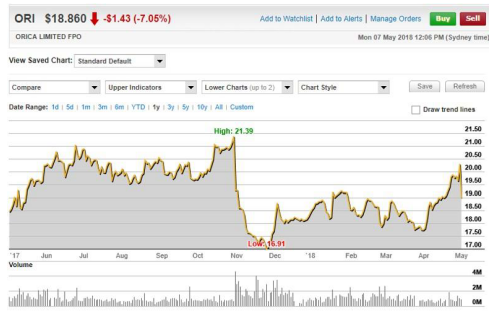
- market should incorporate all information already
- negative earning announcement
- relatively stable
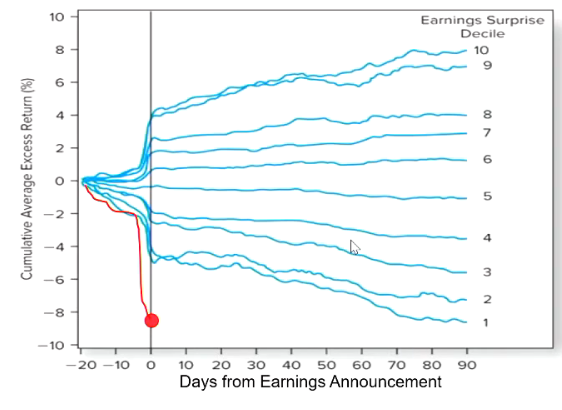
- But investors underreact to news, e.g., post earnings announcement drift (PEAD).
- The evidence is against semi-strong form efficiency
- i.e., Prices do not incorporate all public information quickly enough
days from when earnings are announced
- top group, market did react
- effects continue 90 days after announcement
- according to semi-strong form, should immediately reflect
- investors underreacting to the news
- didn't react quick enough - post-earnings announcement drift
When the announcement is out (group 1, terrible earnings)
- short position, that price will continue to drop
- this is against the semi-string form
- if it is, it should directly drop
Strong-form tests
- Do stock prices fully reflect all information including information known only to insiders (directors, management)?
- If insiders can freely trade on their inside information then we might expect their trading to move price to where it reflects that information
Some studies have found insiders time their purchases and sales very profitably on average.
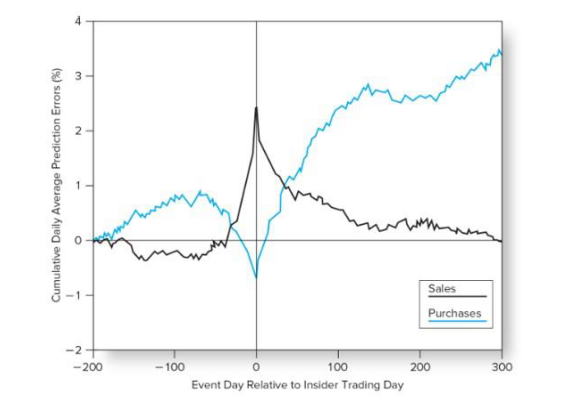
- If market is strongly efficient, wer should see this reflected in stock price
- even insider information should be reflected
Efficient Market Hypothesis - Implications
- Technical analysis: focuses on stock price patterns and on proxies for buy or sell pressure in the market.
- Fundamental analysis: focuses on the determinants of the underlying value of the firm, such as current profitability and growth prospects.
- Because both types of analysis are based on public information, neither should generate excess profits if markets are operating efficiently. That is, either technical analysis or fundamental analysis is not useful in predicting security price movements. Proponents of the efficient market hypothesis often advocate passive as opposed to active investment strategies.
- The policy of passive investors is to buy and hold a broad-based market index. They expend resources neither on market research nor on frequent purchase and sale of stocks. That is, investors would be better off buying and holding an index fund or exchange traded funds (ETFs) than attempting to buy and sell individual securities or actively managed mutual funds. Examples: Track fund (2800) and H-share fund (2828)
- we know it shouldn't use past information to capture profit
- DDM-DCF - value true price of the firm through past financials
- neither of these methods according to EMH should help you
Might as well just do passive investment
Random Walk vs Efficient Market Hypothesis
- Burton Malkiel: Yes, Random walk ➔ Efficient market hypothesis
- Richard Thaler says: No, Random walk > Efficient market hypothesis
- (1) Prices generated by noise traders could be random but could be deviated from the fundamental value.
- (2) A drunk person walks on the street ➔ random walk, but not efficient.
- Alternative interpretation (Richard Thaler)
- (1) Prices are right (EMH) ➔ No free lunch (no arbitrage opportunity)
- (2) No free lunch > Prices are right (EMH)
Nothing can be predicted - supporting EMH
- active management will not
- Even professional fund managers cannot beat the market
- Should be more informed than average investor
Richard Thaler
- noise traders - trading based on noise
- large enough of a group and move in the same direction - form a consensus
- powerful enough to influence the market. Could be trading on misinformation. Not efficient - price is not always correct
- According to EMH, no arbitrage opportunities (no free lunch)
- Because the market has no free lunch, the market is efficient
“Prices are right” vs. “No free lunch”
Ross (2001) and Rubinstein (2001) point to the inability of professional money managers to beat the market as strong evidence of market efficiency. (Do you agree?)
- Barberis and Thaler (2003) argue that this statement is equivalent to the assumption that “no free lunch” implies “prices are right.”
- However, the performance of fund managers tells little about whether prices reflect fundamental value
- EMH, we can't beat the market
- Just because we have random walk, means EMH cannot be true
Efficient Market Hypothesis: Theoretical Foundations
Three arguments
- Investors are rational and they value securities rationally. (=> rational trades)
- Rationality implies efficient market hypothesis.
- However, EMH does not absolutely require rationality.
- Although some investors are irrational, if their trades are random, their irrational trades cancel out each other without affecting prices. (=> irrational random trades)
- EMH does not even require noise traders’ uncorrelated actions. EMH depends on arbitrage (Fama, 1965 and Friedman, 1953).
- Even if there are investors with systematic irrationality, rational arbitrageurs can correct the errors of noise traders. This is by far the most important. (=> no risk for arbitrage)
- The simultaneous buy and sale of the same or essentially similar security in two different markets to take the advantage of different prices.
- We know all investors are not rational
- As long as actions of noise traders are random, they should cancel each other out
- market still effected by rational only
- know not true - gamestop
- short position on gamestop,
As long as we have rational arbitrageurs
- jump in to control the price
- Spot the mismatch in price to spot the arbitrage profit
Efficient Market Hypothesis: Assumptions
-
The argument underlying the EMH is that investors are smart:
- They buy any security that is a “good deal”
- They sell any security that is “overpriced”
-
Competition between investors ensures securities are properly priced.
-
Key assumptions:
- Investors can access to and have the ability to process information
- Investors are rational (rational expectations and expected utility maximization)
- There is no limit of arbitrage
- Know something is a good deal, we want to buy it
- follow the arbitrageurs
- Constant buying and selling, competition ensures price will always move back to the fundamental price
- Information acquisition cost should be free
Given key assumptions EMH to work, no limit or cost, unlimited opportunities
Rationales Supporting Efficiency
Fama (1998): Two reasons
- Anomalies are chance results
- Apparent overreaction to information is about as common as underreaction.
- Post-event continuation of pre-event abnormal returns is about as frequent as post-event reversal.
- Apparent anomalies can be due to methodology (more serious)
- A joint test: Fama (1970) emphasizes that market efficiency must be tested jointly with a model for expected (normal) returns. (we covered in Lecture One).
- Bad-model problems
- Any asset pricing model is just a model and so does not describe expected returns (wrong model)
- Even if there were a true model, any sample period can produce systematic deviations from model’s predictions. (I.e., there are chances for sample-specific patterns). Example: CAPM does not seem to describe expected returns on small stocks (sample specific)
- To limit bad-model problems, one can use the market model or the comparison model approach (how to remedy)
- The bad-model problem is less serious in event studies on short return windows. Bad-model errors in expected returns grow faster with the return horizon than the volatility of returns (short term: less a problem)
Earnings announcement to capture strong EMH?
- not something that can be easily captured
Fama
- Anomalies could be due to chance results
- overreaction to announcements
- Samples/period, random
- may not necessarily be true
Apparent anomalies could be due to methodology
- How do we test for abnormal returns
- To test it, rely on some other asset pricing models
- Calculate with CAPM, etc. To test market efficiency, must model it on something else as a proxy which may not be a good model
- sample period can produce deviations
Fame does not agree the market is efficent
- cannot rule out that it is inefficient - not that simple
- Apparent anomalies can be due to methodology (more serious) – continued…
- The return metric issues
- Theoretical issue: Average “monthly” abnormal returns (AARs or CARs) vs. buy-and-hold abnormal returns
- Statistical issues: each method has its own drawback
- Equal-weight returns vs. value-weight returns
- Adjusted vs. unadjusted cross-sectional correlation
- Most long-term anomalies tend to disappear with reasonable changes in technique
- different methods have their own statistical issues
- How can you say one is better than the other
- Too many variables in the test
- In long time horizons, anomalies tend to disappear
Other reasons: • Behavioral models are specific: Barberis, Shleifer, and Vishny (1998), Daniel, Hirshleifer, and Subrahmanyan (1997), and Hong and Stein (1998):
- Work well on the anomalies they are designed to explain (short-term underreaction and long-term overreaction)
- Other anomalies are embarrassing. • Data mining (Lo and MacKinlay (1990))
- If a sufficient number of variables are correlated, some correlations will be statistically significantly different from zero. I.e., if we search enough, we can always find some anomaly in historical data.
- Repeated visits to the same data set
- Long term data are not more persuasive • Misinterpretation of size effect (Berk (1995))
- Operational size (such as total assets or sales) is unrelated to expected returns, but size is related to average return
- Size is likely to proxy for omitted or misestimated risk • Econometric estimation limitations
- Sensitive to index inefficiency
- Anomalies depend on econometric power • Attribute sorting problem (Ferson, 1996, 1998) - May create the illusion of false risk factors
Cannot generalise it,
- a lot of reasons we cannot claim it is inefficient
Key trading rules that have shown to be effective
Small cap portfolios vs. large cap portfolios?
- Small cap wins out! Portfolios formed based on P/Es:
- Low P/Es do better! Earnings announcements momentum:
- Reaction to extreme announcements is slow!
- Book value (P/E ratios)
- High P/E ratio a gross firm
Key trading rules that have shown to be effective
Value vs. growth portfolios (usually value firm has a high book/market and a growth firm here is one with an absence of value):
- Go for value! Predictable serial correlation:
- Medium-term momentum! Long-term winners vs. losers:
- Reversals: losers become winners!
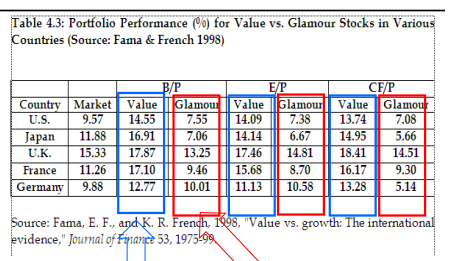
- In Table 4.3, the returns from various value investing (value stocks vs. glamour/growth stock) approaches (that is, using different price ratios as screens) are shown for the United States, Japan, the United Kingdom, France, and Germany during 1975–1995.1
- We see that in all 15 cases value stocks outperformed glamour stocks, where value/glamour portfolios were formed within each country by forming portfolios from the top/bottom 30% of stocks for each year on the basis of beginning-of-year B/P, E/P, and CF/P.
- Value stocks outperform glamour stocks
Reversal evidence
Figure 4.2, based on five-year formation periods and future returns being tracked five years out, indicates that there are substantial differences. The difference between winners and losers is stark, with past losers substantially outperforming past winners.
Also salient from the figure are two other points:
- much of the difference is generated by the strong performance of losers rather than the weak performance of winners;
- much of the return boost/drop occurs in the month of January
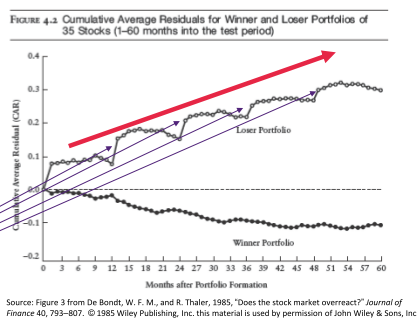
More of the loser stock
- decreasing of the winner stock
- Always an increase/jump, sell loser stocks and buy them back again
- Can't simply look at past and say market is efficient
Momentum evidence
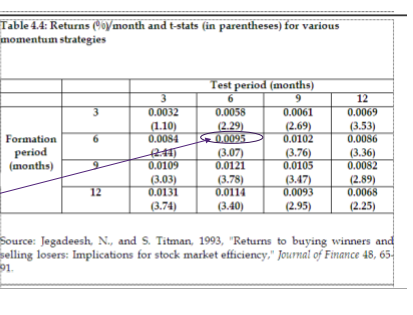
Several years later, intermediate-term (3–12 month) momentum was documented by Narasimhan Jegadeesh and Sheridan Titman. Their approach was similar to that of De Bondt and Thaler except that their return intervals were shorter. Table 4.4 reproduces some key results from their paper.
They found, for example, that a long-short zero-cost portfolio formed on the basis of returns over the previous six months earned an average excess return of 0.95% per month over the next six months.
Also, there is a relationship between post-earnings announcement drift and momentum—though whether momentum disappears after accounting for post-earnings announcement drift is a point of debate.
- See the firms winning, will win in the long term
- follows a momentum
- Can chase (invest) the momentum
- Capture the profits
- 0.95% Excess return per month
Look at the past 6 months performance, and future 6 months performance
Market efficiency requires that only one of the following three conditions need hold:
- Universal rationality
- Uncorrelated errors
- Unlimited arbitrage
- If we can achieve any one of these three, then the market is efficient
- Investors are smart, react to mispricing, and ignoring noisy investor behaviour
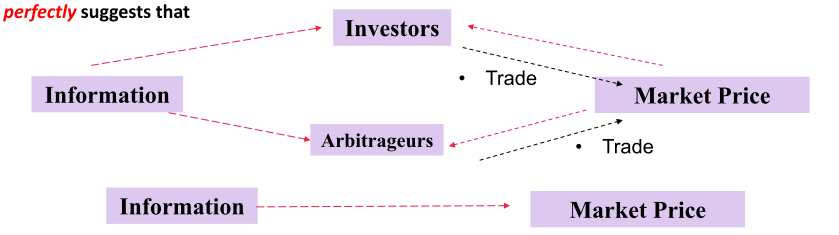
- One of main foundations of EMH is no-arbitrage condition.
- If there are pricing errors (e.g., caused by irrational investors) smart-money traders arbitrage them away.
- No free lunches are left on the table!
- No limits to arbitrage - back to fundamental
- No free lunch setting
How to arbitrageurs capture the profit?
Triangular Arbitrage
Cross rates can be used to check on opportunities for intermarket arbitrage.
Suppose the following exchange rates are available:
- Barclays Bank: Australian dollars per pound sterling:
- Westpac Bank: Australian dollars per Euro:
- Deutsche Bank: Euro per pound sterling: (market)
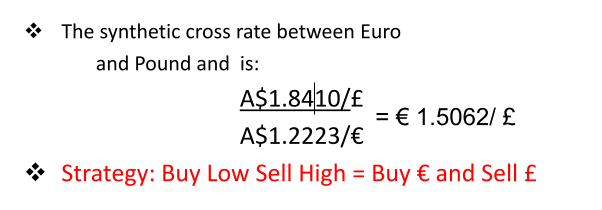
- british pound is overvalued
- overvalued - sell it
Is Arbitrage Risk-free?
However, when a mispricing occurs, strategies designed to correct can be risky and costly, thereby allowing the mispricing to survive for a long time.
Example: A shares vs. H shares
What hampers arbitrage exploitation?
- Fundamental risk
- Noise-trader risk
- Implementation costs
Fundamental Risk
- If you think a stock is underpriced you can buy it, but:
- You might be sideswiped by the market.
- Or maybe by the industry.
- Plus, there is idiosyncratic risk.
- Pure arbitrage seeks to eliminate all of these.
- Problem: you need to find perfect substitutes. Or we can say it is the risk when a perfect substitute is not available.
- Ex 1: Ford is overpriced. Sell Ford and buy GM? But is GM a perfect substitute for Ford? (next slide)
- Ex 2: Huaneng power (902) vs. Datang power (991)
- Perfect arbitrage should not have any risk
- Say Ford is too cheap.
- You buy Ford.
- But market may drop.
- Or auto industry may drop.
- So you buy Ford and short GM.
- But Ford itself may falter without industry or market dropping (idiosyncratic risk) .
- Even you totally manage fundamental risk, there is still noise-trader risk: spread may widen as investors get it even more wrong.
- Industry may drop
- Long short position to offset this risk (hedge)
- didn't hedge unsystematic risk
2) Noise Trader risk
The idea is introduced by De Long et al. (1991) and Shleifer and Vishny (1997). (Noise trader risk is the risk that mispricing being exploited by the arbitrageurs worsen in the short run)
- It has been shown that noise-trader risk is systematic, which means that it cannot be diversified away.
- Real world arbitrageurs cannot wait it out because as professional money managers they do not have long horizons – they are usually evaluated at least at once per year.
== > Three issues:
- (1) Principal – Agent Problems (Horizon Mismatch Risk)
- (2) Creditor Risk (Margin Risk)
- (3) Short Squeeze Risk
- If it becomes sentiment, has potential power to move market
- If we have large enough former sentiment, can move the market
- Noise traders can influence the market as well
- Biggest and bullish enough, can be profitable
It is the systematic risk
- Eventually price should still be corrected
- Not all investors can wait it out
- Also take leverage, causing creditor risk/margin
- price increase, force managers to buy it back and lose money
3) Implementation costs
- In some cases, horizon is short but short-selling is:
- Expensive (commissions, spreads, price impact & fees for shorting stock)
- Difficult or even impossible (lack of availability regardless of fees; legal factors: many institutions cannot short) Plus there is cost of finding these arbitrage opportunities.
- Transaction costs: commissions, bid-ask spreads and price impact can make it less attractive to exploit a mispricing.
- Legal constraints: many pension and mutual fund managers are not allowed for short sales.
- Other costs: the cost of finding and learning about a mispricing and the cost of the resource needed to exploit it.
A lot of resources, time and money
- Add on top to why arbitrage is limited
3Com and Palm
-
March 2, 2000: 3Com carves out in an IPO 5% of its subsidiary Palm.
-
At same time, 3Com announced that in the near future the remaining 95% of the shares would be distributed to current shareholders (roughly 1.5 of Palm/share of 3Com).
-
Two ways of buying Palm:
- Buy Palm directly.
- Buy 3Com getting Palm and rest of 3Com business.
-
Background: Before 2000, 3Com owned Palm (via an acquisition of U.S. Robotics), a maker of handheld computers. 3Com was being ignored by the stock market during the Internet bubble period, especially compared to those sexy Internet companies.
-
To gain the market recognition, on 12/13/1999, 3Com announced that it would sell a fraction of its stake in Palm to the general public via an IPO.
-
In this transaction (called equity carve-out), 3Com retained ownership of 95% of Palm shares.
- Palm going public
- selling 5% to investors, or get shares through 3Com
Buy 3Com, get both

3Com's price dropped by 21%
- “Smart” investors were limited in their ability to short-sell Palm (as documented in Lamont and Thaler), so it wasn’t their fault.
- But this cannot explain why anybody would buy Palm instead of 3Com – for this one needs irrationality.
- In facts 2 things are needed for mispricing to exist:
- Irrational investors
- Limits to arbitrage (here due to implementation costs)
- 3Com & Palm case illustrates that mispricing does not imply a free lunch!
- Both limits to arbitrage we also need irrational investors to have mispricing
- no limits to arbitrageurs, can be corrected straight away
- know 3Com undervalued and Palm overvalued, have limits to perform arbitrage
Conclusion
- There are investors who are not fully rational. Furthermore, investors are deviated from rationality in a systematic and consistent way.
- The systematic and consistent irrationality cause security prices deviated from their fundamental values.
- However, arbitrage is risky and therefore is limited and mispricing may be worsened before getting better.
- Do not jump in the conclusion too early to assume that noise traders are the losers.
- Noise traders take on more risk and they need not die out and may make more profits.
- Go is a systematic and inconsistent way
- security price will deviate from fundamental value
- arbitrage is risky and expensive
- Best price can get worse before it gets better
- With that information, noise traders are not always losers - more willing to take risk
- Can outperform professional managers
