Tutorial 10 - Topic 9 Behavioural Factors and Stock Market Puzzles
1*. Differentiate the following terms/concepts:
a. Certainty equivalent and a gamble
A certainty equivalent is the wealth level that leads a decision-maker to be indifferent between a particular prospect and a given wealth level and a gamble is a lottery or series of wealth outcomes, each of which is associated with a probability.
b. Loss aversion and myopic loss aversion
- Loss averse- losses loom larger than gains
- Myopic loss aversion implies the person also evaluates her portfolio frequently
c. Speculative price bubble and ex post rational stock price
- Speculative bubble is said to exist when high prices seem to be generated more by traders' enthusiasm than by economic fundamentals
- Shiller defines ex post rational stock price as the stock price if you actually knew all future dividends
d. Greater fool theory and speculation
- Greater fool theory suggests that people buy assets that the realize are overvalued because they think these is a foolish individual that will pay even more
- Traders speculate on risk in order to earn returns (e.g. speculators may drive up prices by betting in future price increases)
2*. In a Ponzi scheme, named after Charles Ponzi, investors are paid profits out of money paid by subsequent investors, instead of from revenues generated by a real business operation. Unless an ever-increasing flow of money from investors is available, a Ponzi scheme is doomed to failure. What’s the difference between a Ponzi scheme and an asset price bubble?
- Ponzi scheme are generated by fraudulent schemers and the existence of a price bubble does not necessarily suggest fraud
- Occurs naturally in the financial market, characterised by a rapid escalation in the market value of assets
3*. An individual with cash to invest has two investment choices:
Buy a stock fund which every year either earns 40% or -20% with a 50/50 probability. Buy a bond fund that every year returns either 5% or 0% also with a 50/50 probability. Assume that the returns on the two funds are independent and that returns from year to year are also identical. Also, assume an initial portfolio value of $1. (The answers, however, will be unaffected if you use a different initial portfolio value.) In addition, suppose the value function is linear and is specified as:
-
Depends on the frequency on how they look at their portfolios
-
V(year 1) = -0.1
-
V(year 1) = 0.025
- 0.025 (second option) preferred
-
V(year 2) = 0.03
-
V(year 2, second option) = 0.052
- 0.052 (second option) still preferred
b. How does your answer to Part (a) help us understand the equity premium puzzle?
- frequency of evaluation can affect the investor's risk preference and perceived utility
- Difference between both narrowed
- Always assume the investor is calm and peaceful
- the lower the lambda is, the short the horizon at which the first stock fund will be preferred
- E.g. if the lambda is reduced to 2, the stock funds is preferred at 2 years
- The stock fund would also be preferred sooner if the expected return on the stock fund is higher
- Question illustrates myopic loss aversion, indifference between stocks and bonds
- Helps align theoretical predictions with empirical observations regarding stock and bond returns
4*. What do experimental bubble markets teach us about the likelihood of bubbles in the real world? In what sense does this research have its limitations?
- If bubbles (mispricing) can generate simple market structures, it seems they would be fairly likely in much more complicated naturally occurring markets.
- This research allows a great deal of control for extraneous factors, but people may behave differently in a controlled laboratory situation.
5*. Do you believe that stock prices are too volatile? Be sure to explain what you mean when you say “volatility” and “too much.”
Believing Stock Prices are Too Volatile:
- Risk Perception: Some may argue that excessive volatility can be problematic because it increases the perceived risk associated with investing in stocks. This can deter potential investors and contribute to market instability.
- Market Efficiency: Those who advocate for lower volatility might suggest that it ensures a more efficient market where stock prices reflect fundamental values rather than being influenced by short-term speculation and emotional trading.
Believing Stock Prices are Not Too Volatile:
- Market Dynamics: Volatility is a natural characteristic of financial markets. It allows for price discovery, as stock prices react to new information and market events. A degree of volatility is essential for markets to function efficiently.
- Investment Opportunities: Some investors actively seek out volatile markets as they provide opportunities for profit through short-term trading strategies. To them, volatility represents a chance to capitalize on price fluctuations.
- Diverse Perspectives: What one person considers “too much” volatility might be seen as an opportunity for another. It’s subjective, and investors have varying risk tolerances and investment objectives.
- Depends on one's perspective ad the context in which we evaluate volatility
- Volatility, in the context of stock prices, refers to the degree of variation or fluctuation in the proces of stocks over a specific period
6*. A series of questions related to the equity premium puzzle:
How is the equity premium typically calculated? 6-1 Suppose the average real return on equities over the past decade was 8% per annum and the average real return on government bonds was 2% per annum. Calculate the average equity premium over the past decade.
- equity premium - avergae return on stocks - risk free rate
6-2 If in a given year, stocks returned 15% and Treasury bills (risk-free rate) returned 4%, what is the equity premium for that year?
- 15 - 4 = 11%
6-3 A researcher believes that rare disasters can explain the equity premium puzzle. He states that if equities can lose 50% of their value with a 2% chance in any given year, this can justify a high equity premium. Using these numbers, what would be the expected loss due to these rare disasters?
- expected loss = Probability of Disaster x Magnitude of loss
- Expected loss = 0.02 x 0.5 = 0.01
- this means that the expected annual loss from a rare disaster is 1%
6-4 Define the Equity Premium Puzzle
6-5 How do ‘rare disasters’ play into some explanations of the Equity Premium Puzzle?
- equity premium can be rationalised if there is a small probability of a rare disaster
6-6 Name two popular explanations for the Equity Premium Puzzle.
- Risk Aversion and Consumption habits
- CRRA = 30, much more implausible
- Behavioural finance, psychological factors and biases
- myopic loss aversion, investors are overly sensitive to short-term losses, leads them to demand a higher premium for holding stocks
Part Two: CFA Questions
Ravi King is an advisor with an investment management company that classifies all investors into one of four Behavioral Investor Types (BITs): Passive Preserver (PP), Friendly Follower (FF), Independent Individualist (II), or Active Accumulator (AA). King prepares for a meeting with Amélie Chan, a client who exhibits moderate risk tolerance. King believes that Chan’s prior investment choices are consistent with her BIT. In their last meeting one year ago, Chan expressed an interest in owning shares of a small, local startup company that she had heard about from friends. King explained the high level of risk associated with that investment idea, and Chan agreed that he should not buy the shares for her account. King recommended that Chan instead invest in shares of another company, Avimi S.A. The investment management company’s data-backed research report suggested that the Avimi shares were undervalued. Chan agreed with King’s recommendation, and King bought shares of Avimi for Chan’s account. King will meet with Chan tomorrow and present the investment management company’s updated research report on Avimi. The report justifies his belief that the shares are now overvalued, and he will recommend that Chan sell her Avimi shares.
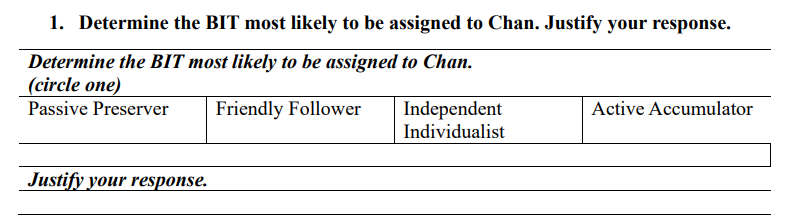
- Chan is most likely to be identified as a Firendly Follower (FF)
- Chan exhibits moderate risk tolerance
- Chan tends to follow leads from her friends and advisor when making investment decisions