Module 3 - Multiple relation SQL queries
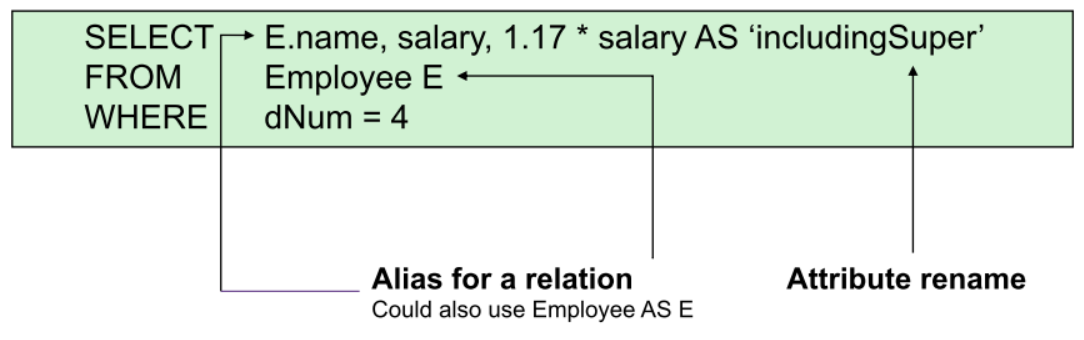
Renaming
- SQL provides the facility to rename attribute and/or table names.
- Renaming assists in removing ambiguity and specifying self-joins. Two options:
- Qualifying attribute names
- Declaring an alias
Cartesian Product
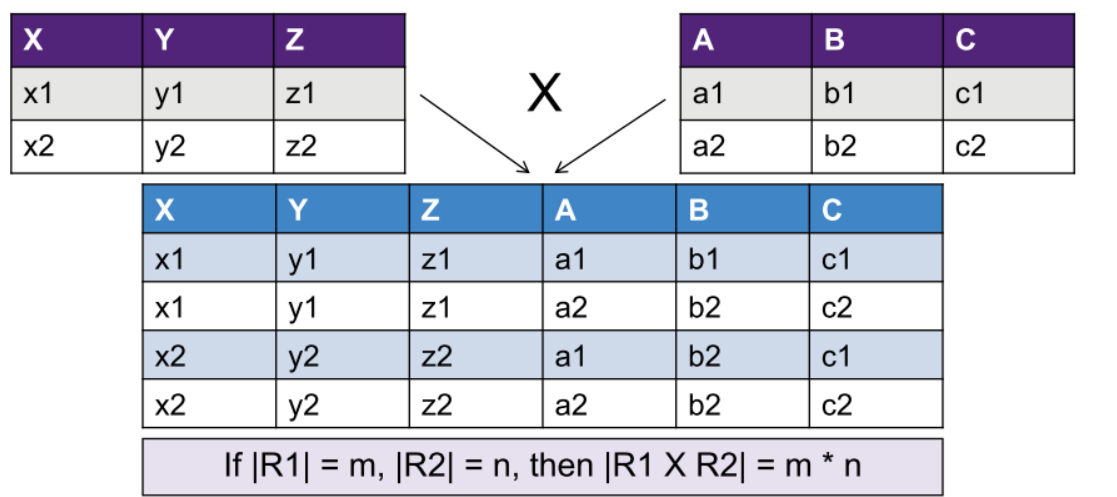
Also known as a CROSS JOIN
- R1 X R2: every row in R1 is combined with every row in R2 to form tuples in the result relation
- The schema of R1 X R2 is the concatenation of all the columns from R1 and all the columns from R2
Joins
- A join is used to combine related tuples from two relations into a single tuple in a new (result) relation
Example
A few weeks ago we had an Example ER model like this:
Focus on EMPLOYEE and DEPARTMENT, and the MANAGES relationship
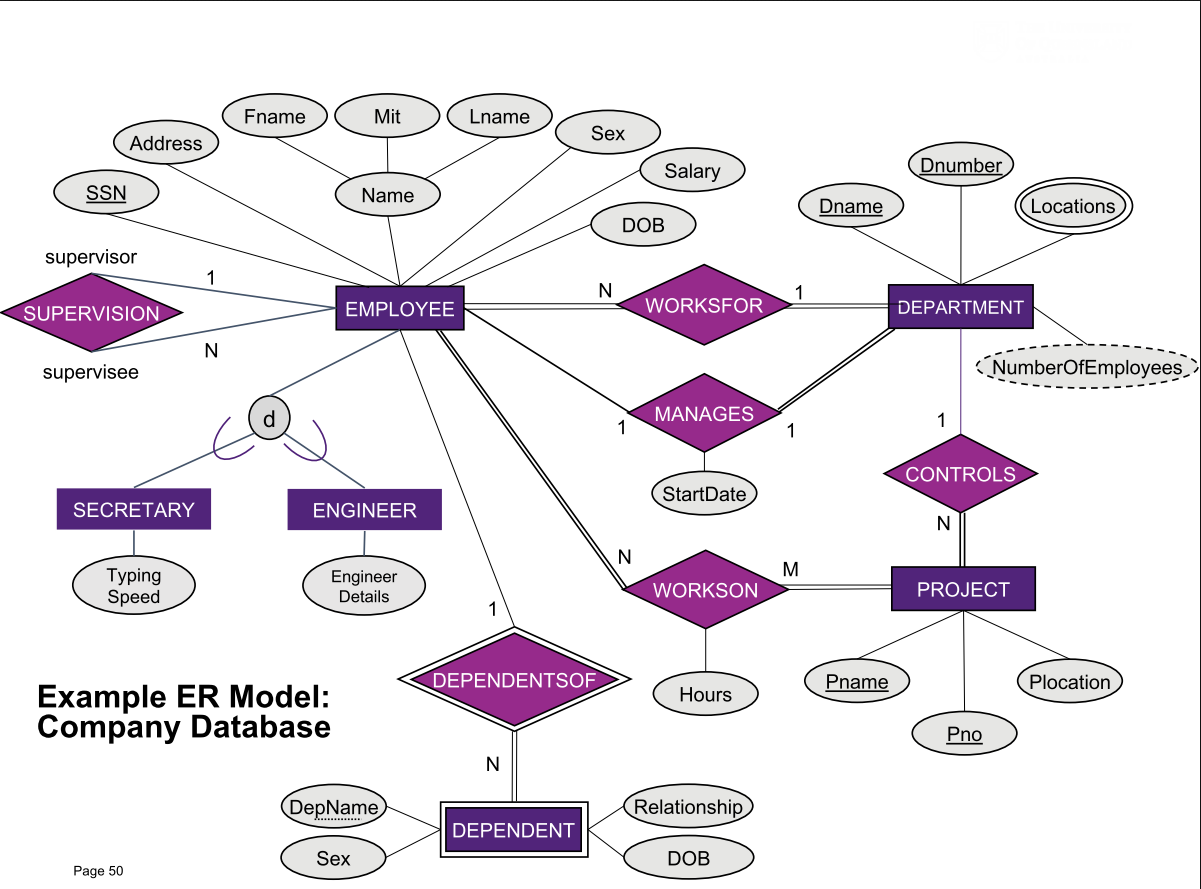
There two relationships were mapped as such:
- EMPLOYEE {SSN, Address, Fname, MIt, Lname, Sex, Salary, DOB, SupervisorSSN}
- DEPARTMENT {DNumber, DName, ManagementStartDate, mgrSSN}
- DEPARTMENT mgrSSN references EMPLOYEE.SSN
I know:
- For every Department, there is exactly one Employee that manages it
How can I connect both of these relations (tables) into one long table so that I can see the department and its respective Employee?
Equi-joins in SQL - Examples
-- Equi-join using WHERE
SELECT E.name, D.dName
FROM Department AS D, Employee AS E
WHERE D.mgrSSN = E.ssn;

-- Equi-join using JOIN
SELECT E.name, D.dName
FROM  Department AS D
JOIN Employee AS E ON  D.mgrSSN = E.ssn
Theta join
- We join two tables together by satisfying some logical condition
- The most general type of join is called theta-join
INNER and OUTER joins
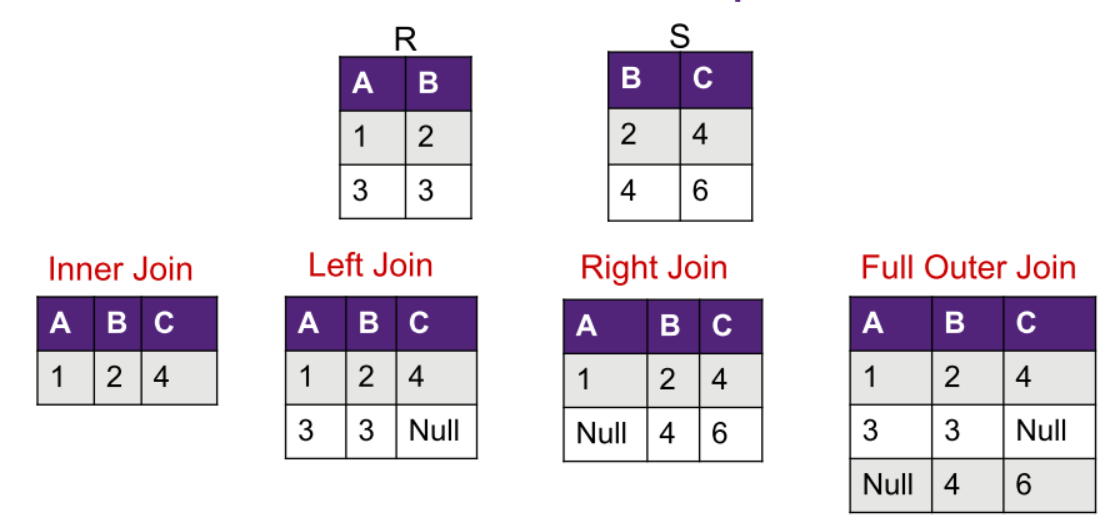
- Inner Join: A tuple is included in the result relation only if matching tuples exist in both relations. By default, just using the JOIN key word will specify INNER JOIN
- We should still aim to write INNER JOIN instead of JOIN even though the functuonality is the same. Why?
- Outer Join: includes the result of the inner join plus unmatched rows in one or both tables can be returned.
- Left Join: Includes all rows from first table
- Right Join: Includes all rows from second table
- Full Outer Join: Includes all rows from both tables
- Some DBMS (SQLLite) do not have support for a RIGHT JOIN. Why?
MYSQL does not support
FULL OUTER JOINoperations. How would we achieve the same result without the operation?SELECT * FROM t1 LEFT JOIN t2 ON t1.id = t2.id UNION SELECT * FROM t1 RIGHT JOIN t2 ON t1.id = t2.id
Set operations
- Union
- Intersection
- Difference/Minus
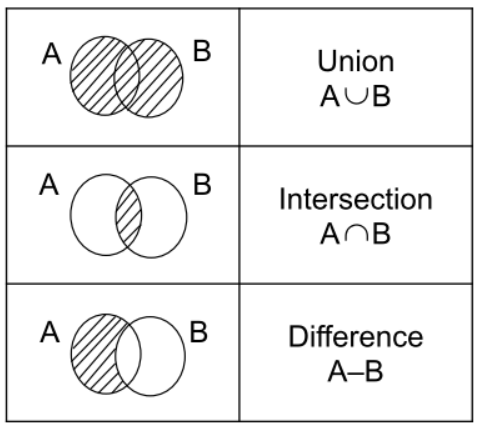
Use of ALL
Each automatically eliminates duplicates;
- To retain all duplicates use the corresponding multiset versions:
- UNION
ALL, INTERSECTALLand EXCEPTALL.
- UNION
UNION
- Produces a relation that includes all tuples that appear only in R1, or only in R2, or in both R1 and R2.
SELECT  starID
FROM  Movie M
JOIN StarsIn S
ON M.movieID = S.movieID
WHERE year = 1944
UNION
SELECT  starID
FROM  Movie M
JOIN StarsIn S
ON M.movieID = S.movieID
WHERE year = 1974
INTERSECTION
- Produces a relation that includes the tuples that appear in both R1 and R2.
Example: Find IDs of MovieStars who’ve been in a movie in 1944 and 1974.
SELECT  starID
FROM  Movie M
JOIN StarsIn S
ON M.movieID = S.movieID
WHERE year = 1944
INTERSECT
SELECT  starID
FROM  Movie M
JOIN StarsIn S
ON M.movieID = S.movieID
WHERE year = 1974
Difference - EXCEPT/MINUS
- (also referred to as MINUS) produces a relation that includes all the tuples that appear in R1, but do not appear in R2.
Example: Find IDs of stars who have been in a movie in 1944 but not in 1974.
SELECT   starID
FROM     Movie M
JOIN StarsIn S ON M.movieID = S.movieID
WHERE year = 1944
EXCEPT
SELECT   starID
FROM     Movie M
JOIN StarsIn S ON M.movieID = S.movieID
WHERE year = 1974