Normalisation
Key concepts
Superkey: a set of attributes such that no two tuples have the same values for these attributes
- That is, its closure contains all attributes in the relation
(Candidate) key: a minimal superkey where none of the attributes can be removed to create another superkey.
- Minimal ≠ shortest
- There can be many candidate keys for one relation
- Any superkey must contain at least one candidate key
Primary key: one of the selected candidate keys
- There can be only one primary key for a relation
Prime attribute: an attribute in any candidate key
- Not necessarily a member of the primary key!
Non-prime attribute: An attribute that is not a member of any candidate key
Example
R[A, B, C, D, E]
A → B
C → {D, E}
{A, D, E} → C
{B, C} → A
Normalization: the process of identifying redundancy from data
Normalization is a process that aims at achieving better designed relational database schemas using
- Functional Dependencies
- Primary Keys
The normalization process takes a relational schema through a series of tests to certify whether it satisfies certain conditions
- The schemas that satisfy certain conditions are said to be in a given Normal Form
- Unsatisfactory schemas are decomposed by breaking up their attributes into smaller relations that possess desirable properties (e.g., no anomalies)
Normalisation Overview
| Form | Description |
|---|---|
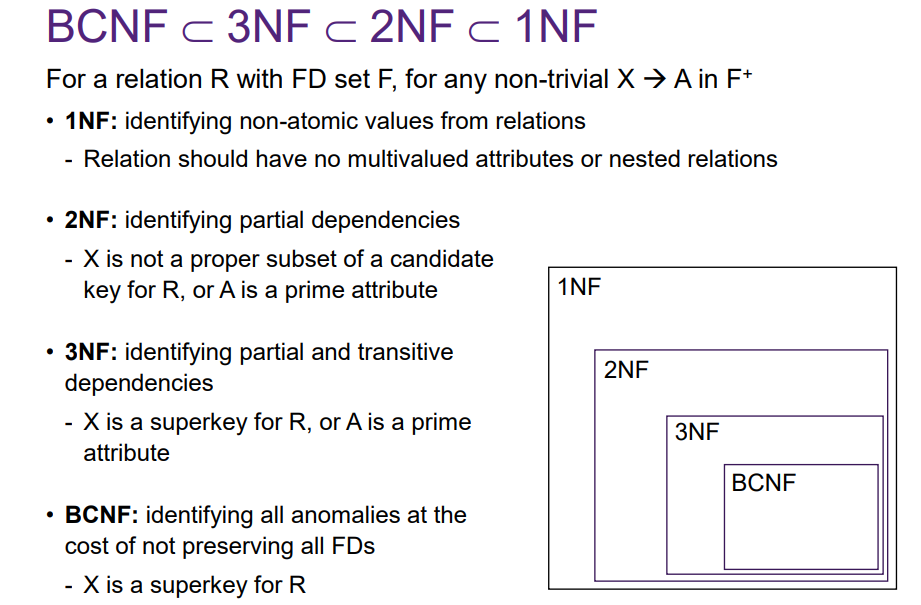
| 1NF | Outcome: Identifying non-atomic values from relations. Test: Relation should have no multivalued attributes or nested relations. |
| 2NF | Outcome: Identifying partial dependencies, which helps remove some anomalies. Test: LHS of any non-trivial FD in F+ is not a proper subset of a candidate key, or RHS is a prime attribute |
| 3NF | Outcome: Identifying partial and transitive dependencies, which helps remove most anomalies Test: LHS of any non-trivial FD in F+ is a superkey, or RHS is a prime attribute. |
| BCNF | Outcome: Identifying all anomalies at the cost of not preserving all FDs Test: LHS of any non-trivial FD in F+ is a superkey. |
1NF
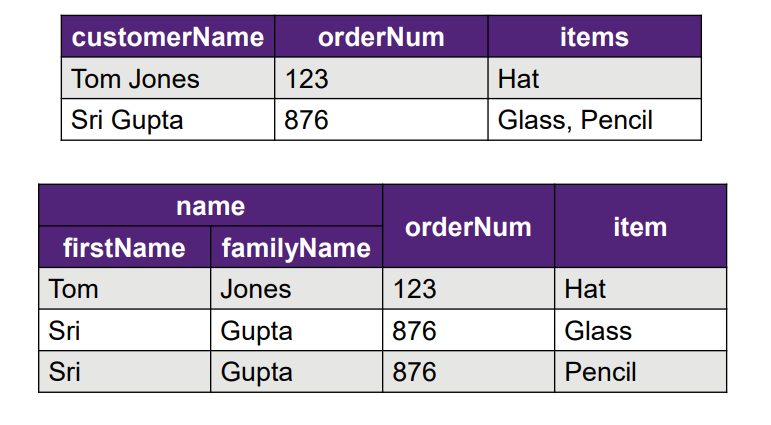
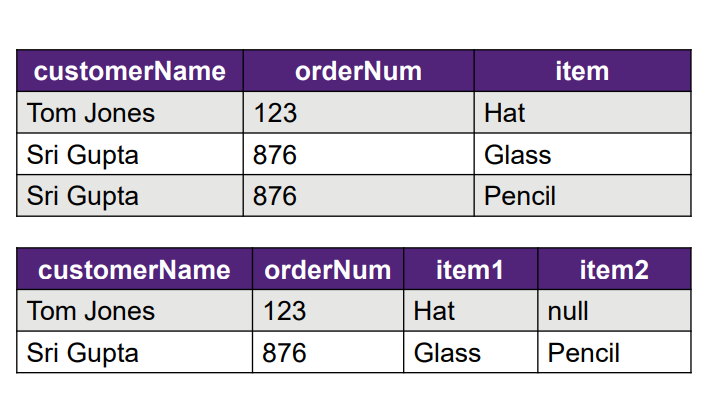
- The value of an attribute is a single value from the domain of that attribute
- 1NF disallows having a set of values, a tuple of values (nested attributes), or a combination of both
| Non-1NF relations | Normalised to 1NF |
|---|---|
 |
 |
2NF
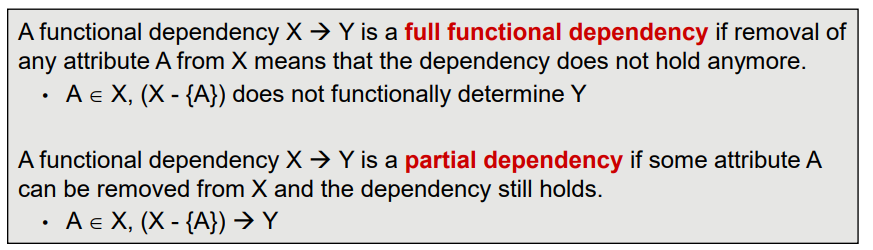
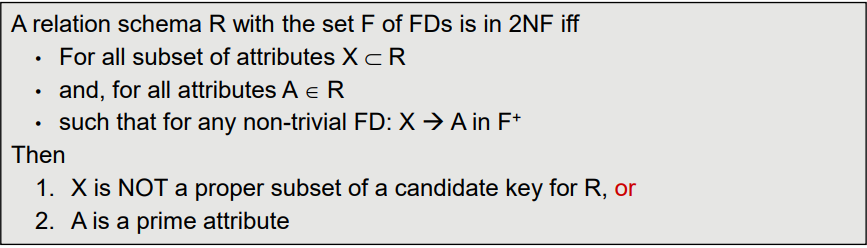
A relation schema R is in 2NF if every non-prime attribute A in R is fully functionally dependent on the primary key of R.
- 2NF can be said informally to have no partial dependency
More Formally
3NF
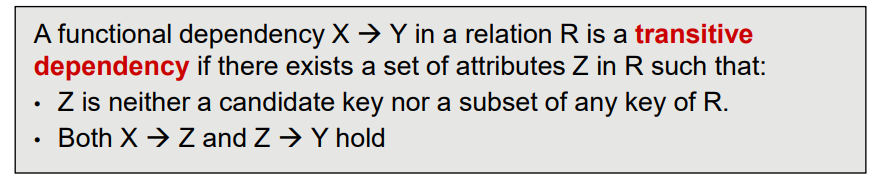
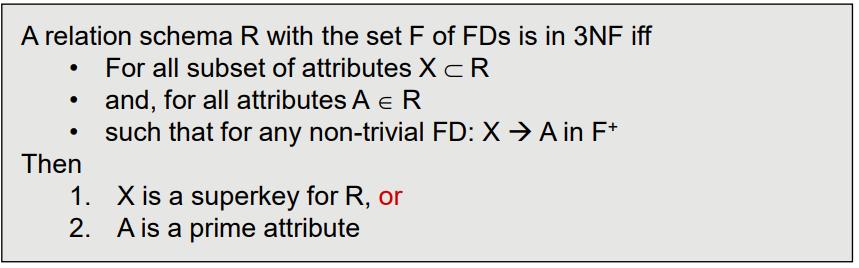
In other words, a relation is in 3NF iff for any non-trivial FD X A, where A is a non-prime attribute, X must be a superkey
BCNF (Boyce-Codd Normal Form)
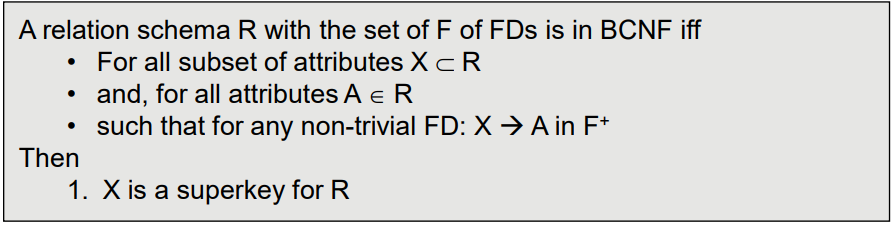
Informally: Whenever a set of attributes of R determine another attribute, it should determine all the attributes of R.
Relational Database Schema Design
BCNF synthesis
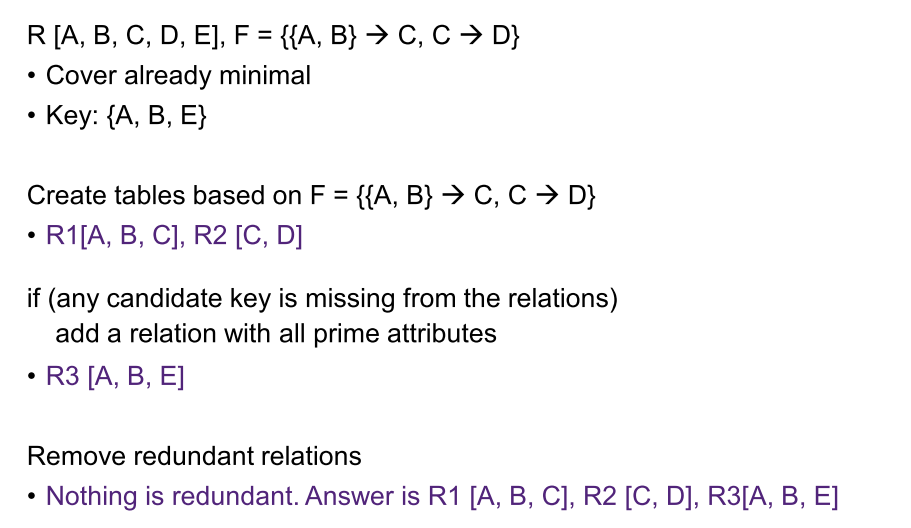
3NF synthesis
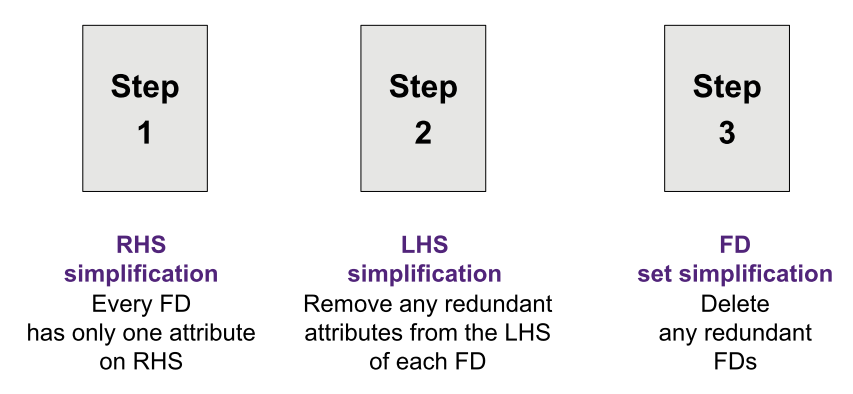
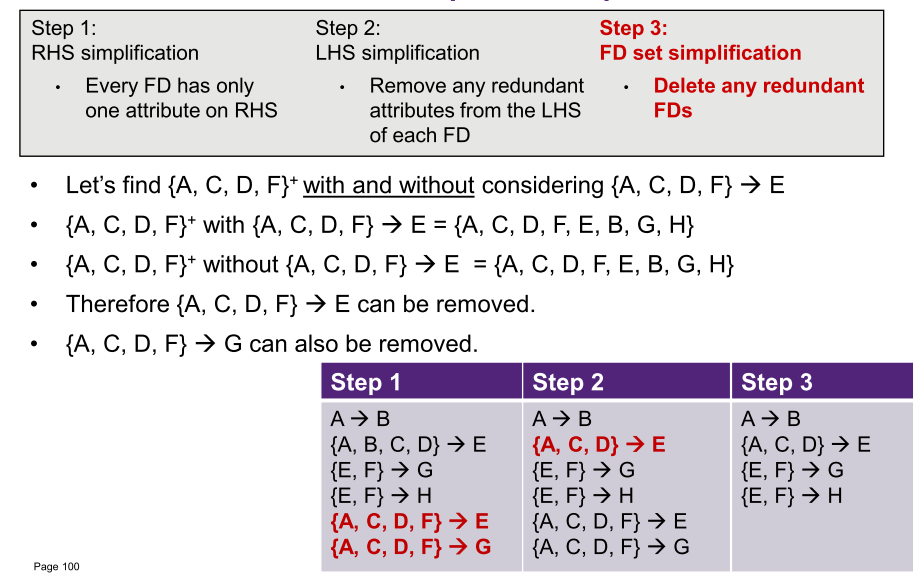
Finding minimal cover:
Synthesis